Showing posts with label Atlantic crossing. Show all posts

Thursday, 22 January 2015

Trans-Atlantic in pictures

Enki motors up the west coast of Antigua

We arrived at Jolly Harbour on the west coast of Antigua four days ago. On our way in we registered the basking sharks and turtle off Irish bank, and the stunning blue of the shoal water. Our friends from Angel Louise, Ed and Sue Kelly, brought their dinghy out to meet us in the channel and guided us into the customs dock. So kind of them. Since then the local life and the colours have smudged and smeared. We kind of collapsed. Not actually, because we've been busily putting the boat back together, but as Alex says, the adrenaline letdown has been severe.


I won't write anymore about the crossing. Memory has begun its work of organising the experience into a few defined points (yes, Cathy Cook - just like childbirth).  Alex didn't take very many photos. He had too much else going on. When we reached for the camera it was often to photograph clouds. There was a lot of cloud action out there and clouds are very obliging photographic subjects. The sea on the other hand is famously resistant to being frozen in time.  Its essence is motion.


So here's a strip of photos of the ocean, the sky, the boat and of us for your (and our) retrospective enjoyment:

Departure  pic - skipper with attitude
The first few calm days gave us a chance to fine-tune the pole set-up

Calm enough to commune with dolphins riding the bow wave (below)


A Spanish tipple on New Year's Eve

Dust from Africa shrouded the sky for several days (and below)


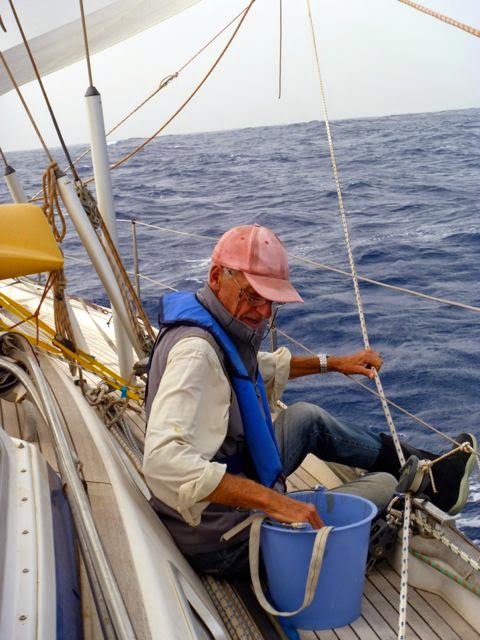
Alex working on deck (and below)


Our daily noon positions (marked with an X)

We give thanks daily for the hard top

As the squalls build, we start to look crazier


HF radio contact was very difficult, and became impossible


The squall lines just kept on coming

Barb and Andy's gift of a Coast beanbag was never more appreciated

Moving mountains

A man's best friend - strapped down with shock cord

Heavily reefed genoa (and mainsail looked much the same)

He's enjoying himself (and below)


You can taunt yourself with miles-to-go, and ETA

It wasn't tropical

Sundown

12 hours of darkness...

And the sun also rises again.

On the 18th day, the sails came out - "normal" trade winds

Easterly wind all the way, until it turned to the south - northerlies missing in action

Flying fish, and mis-directed camomile teabag

We're on the same page now as the Caribbean Sea 

You could get bored with weather like this

Time to raise the quarantine flag
It's safe to go to the stern seat now

He's not sure if he wants to go ashore

Sharks on approach to Jolly Harbour

Ahoy sailors - Ed and Sue Kelly come to meet us with the Go-Pro

Chatting to Ed at the Port of Entry, Jolly Harbour

We have so little idea about what to expect from the Caribbean, despite having a plethora of cruising guide books. Thus far we've been occupied with getting the generator working again (done), organising better security onboard, cleaning up, getting the dinghy and kayak back in the water, and so on. We opened our first over on West Indian soil by catching a local mini-bus into St John's, the capital of Antigua to buy phone credit. I was so foggy I forgot to go to the market which was right by the bus station. Things can only get clearer.

St John's, Antigua  (and below)


Sunday, 18 January 2015

On our last leg(s)

Mid-morning on the first day of our fourth week at sea, and the hatch in the aft cabin is pushed wide open, as is the galley port and the cockpit "windscreen". We won't get wet today. The surface of the ocean is ruffled with small polite frills, nothing broken or torn. The boat is sliding across long slow swells, being blown towards the south coast of Antigua by a very light southeasterly. There's nothing rough or confrontational about this breeze. It will rock Alex to sleep in an instant.

Last night we motored for several hours. We haven't done that since our first night out of Lanzarote. But we're on the home straight now, with no worries about fuel. Unless something untoward happens, at this time tomorrow we should have cleared into Antigua and...my mind goes blank. What do we do when we make landfall? We wash the boat, that's what. Sluice off the salt. Gather up the dirty laundry. Let's not go any further. You were thinking Caribbean punch? Or a splash in turquoise water? I am too, and that will come in good time. We look after Enki first, and then ourselves. That's the way it is with boats. They reward you for your devotion, generally.

When the sun reappeared after our week of being smothered by dust, followed by a week of squalls, high wind and rain, it was enough just to sit and soak up its bright warmth. The wind dropped, the sea subsided. We hadn't realised how exhausted we were. For the past three days we've been floating along in this idyll, and now, with the crossing almost over, we are allowing ourselves to think about what comes next. This is where the planning gets a bit fuzzy.

What we HAVE decided is that we are not going up the east coast of the US to have a look at Chesapeake and maybe Maine. This was tempting. Is tempting. But time is short. Or it seems short. Perhaps it won't turn out that way, but you have to make a call. We will turn south from Antigua and continue on in the direction of the Panama Canal. Whether we have the energy to transit the canal and then cross the Pacific this year is something we're not sure about. Since you get to do this only once (or we do - the indefatigable Galactic has just completed its third Pacific crossing) we want to do it in the best possible frame of mind and body.

Back to now. In my last post, I waffled on about not being zen enough to do long ocean passages. Perhaps I was just tired and missing my books. The concentration required to sail in those winds and seas is intense. There were several days when Alex and I stopped talking except to communicate the bare essentials. "Pull it on, " he might say to me, and I'd reply, "Pull what on? I can't see which colour rope you're holding." He'd counter tersely: "Look at the the front of the boat and not behind you." I'd resist the urge to say I can't swivel my body at the waist 180 degrees. You get the drift. Believe it or not, we manage quite well, but it's not just chafed lines you have to worry about on a long passage in a small (well, comparatively) boat. Chafed emotions need attention too. You bind them with silence to keep them from unravelling. It seems to work in the short-term.

When conditions allow, more discursive styles of conversation can resume. And do.

There will be other times at sea when the primary communication mode will be orders given and orders taken (I exaggerate, but not by much). When you take a marriage offshore, you make yourself vulnerable to the most profound, and yet subtle of shifts. You become skipper and crew. It's something to be managed. Something to keep in context. Something to accept as you accept not ever leaving the cockpit at night if you are on watch alone (even to sit on the perfect star-gazing seat on the stern of the boat) and forgoing brewing loose-leafed tea in a tea pot (it always ends in grief - use a teabag). There's lots to look forward to when we fall over the finish line tomorrow. The question is, how soon will it be before we stand up and say, "Let's do that again".

----------
radio email processed by SailMail
for information see: http://www.sailmail.com

Tuesday, 13 January 2015

It's swell, really

There was a point yesterday when I decided that this had gone on long enough. I'm not fidgety or bored or deprived in any way (except of course of 8 hours of solid sleep). No, it's more a temperament thing. I'm just not zen enouugh. Not blissed out, Moitessier-ed (after the nomadic Frenchman who did for crossing oceans what Jack Kerouac did for being on the road). From everything I've read and been told about long ocean passages, there is a state of being you arrive at where you just want to keep sailing. The non-watery world loosens its pull on you. That's always quite appealed to me.

I imagine the zone feels like a good yoga class. Pain recedes (exhaustion too), time is suspended, your mind slows down and you focus on what is immediately to hand. In yoga, that's your breathing and your body's balance. On the ocean, that's the impact of the wind and the waves on your boat. It's probably easier to get in the zone without all the electronic gizmos which are the interface we elect to use now and which make modern boating safer, more comfortable and less fraught. Alex is always telling me I'm a romantic who would wilt at the first abrasion on my hands from salt-encrusted hemp lines and sodden canvas sails. He's right, but I'm all for seeking some romance in this adventure of ours.

I find it in the swells. I especially love them in the morning when the sun is still low in the east and for a millisecond before a hefty watery mountainside collapses on itself, you get a flash of translucent aquamarine on its crest, and the breaking tips of the waves appear lit from the inside. I love the flying fish too, those tiny winged silver missiles which skim and ride the air currents above the troughs.

The high seas in high spirits are a magnificent sight when the sun's out, but not so appealing in the pitch black, when the wind is swinging around under the clouds, not to mention rain spilling out of above clouds. We've had a pretty rough time of it this past week. I don't know how the mythical bath-tub sailor gets on in such conditions, but we've been working the boat and ourselves hard. You need a cool head to gybe a big boat in any conditions, but especially so in strong trade winds.

I knew that trade winds were brisk and constant. That's why sailors love them. You need a bit of oomph to push along a big ship (I'm thinking here of all the thousands of big sailing ships which have plied this route since Columbus). But that trade winds come in various strengths, like coffee, is something I hadn't fully realised. I'd expected Force 4 or 5 (using the Beaufort scale), but for the past six days and nights we've been served up Force 7 and 8. The ristretto level of trade winds, rather than the Americano.

We don't mind strong wind. We've been making very good speed. Even with her sails well-reefed down, Enki is a powerful boat. It's a thrill to feel her slice a straight furrow through the water, and surge across a wave face, to appreciate her balanced sail trim (thanks Alex) and how responsive her autopilot is 95% of the time. However, there's been no slacking around since the very strong trades blew in. The person on watch is truly on watch, keeping an eye on swell angle, wind shifts, approaching squalls, potential autopiliot flipout... I'm hoping to get back to those nights where I settled myself into the beanbag on the floor of the cockpit, in front of the wheel, so as I could see the instruments when I looked up from my book...and in the early hours, I even managed to catnap with an alarm clock in my hand set for 20 mins hence.

Tonight, finally, the winds are weakening, and there's supposed to be a touch of south sneaking in on Friday. That'll blow us straight towards landfall sometime next Sunday (18 Jan), or perhaps later. There's time still to get in the zone.

----------
radio email processed by SailMail
for information see: http://www.sailmail.com

Thursday, 8 January 2015

Already half gone

Missing item: comforting cotton-wool clouds. They're supposed to be standard issue on a tradewinds passage. Well, not this one. Some atmospheric prankster swapped the boxes around. What we've had to play with this past week is a huge dirty shroud of Sahara dust which blotted out the sun, and which was replaced last night by marauding squall bands which creep up on a clear sky with intent to spoil and lay waste. What's the deal here?

The deal is, you take what you're given, and you run with it. Day and night. Best to look on the bright side. The swell is 3 m not 5 m. The moon is glaringly full so as well as hearing the swell on approach you can admire the whipped foam topping. Enki is creaming it under a well-reefed main and genoa. Very stable, autopilot very reliable. "Give me some gorillas to trim the sails and we'd be flying," says the skipper. He's a hard man to please, but if you push him he'll say he's happy. He loves his boat. "Look how balanced the wheel is," he says. "I can bend over and light a fag and it doesn't move." Of course, the ultimate boat performance test.

We're halfway across, give or take a few miles, and if the past few days are any indication, the second half of the voyage promises a much more respectable average speed. The skipper starts to get the wobbles if Enki's speed pushes 8.5 knots, but not nearly as often as the woman at the stove wobbles. This boat rocks. Cooking is an extreme sport, involving lunges towards a sliding pot, lurches after runaway cutlery, juggling a stack of fridge baskets, damming a cascade of plastic lids and containers, moving non-slip mats around the bench with the speed of a hockey player dribbling a puck. I think I've got as many bruises as a hockey player now too.

Are we having fun? Of course. I'm not bored yet (that was my hope - that the weather would be so benign that the boat sailed itself and boredom set in). It's busy out here. Nothing to see but waves and clouds (and right now, dolphins), nothing to do but keep a boat moving west. But there are "jobs". Running the generator, checking the lines for chafe, baking, sprouting (mung beans, beards). Even pulling on your wet weather gear and clipping the toys, as we call the personal AIS, personal EPIRB etc, onto your harness, takes a good 15 minutes. Getting a clear run with the HF radio is sometimes an all-day effort. Until the swell made it so wretched, I've been keen in the kitchen. We read to go to sleep - and we seem to often be trying to go to sleep. With this iffy weather the option of catnapping in the beanbag in the cockpit during the night watch is closed. All eyes on the dials. I've re-discovered the pleasure of having stories read to me. Last night I put an ear bud in one ear, selected my story from the New Yorker short fiction podcast, and listened in stereo to the story and the wind and the waves. It's rare to see a ship now, but of course we need to keep checking because sometimes, believe it or not, you are where you don't want to be. Last night Amy C on her way to Rotterdam altered course in order to avoid us, after Alex contacted the bridge by radio. What are the chances in this wild ocean?

We've got a cute algorithm on the chart plotter which calculates our ETA, depending on our boat speed. Some times it says we're going to arrive on the 18th, sometimes on the 19th, sometimes on the 16th. Such information is meaningless, and contrary to the spirit of the endeavour. It's just a bit of fun. We've still got 1400 miles to go to Antigua. That's a few more changes of wet weather gear in the dead of night.

----------
radio email processed by SailMail
for information see: http://www.sailmail.com

Saturday, 3 January 2015

Poled out

This run across the Atlantic via the Canary Islands is generally considered to be a bit of a cakewalk . You could do it in a bathtub, I heard one Frenchman say on the dock. Just a matter of going south until the butter melts, at which point you hang a left and keep going till you hit the other side. Once you've set your sails you hardly need touch them for the next 2000 miles. It's downwind all the way, a sleigh ride on the great ocean swells under a blue sky ranged with rows of cottonwool balls. The tradewinds clouds. These are the stories anyway.

The butter's got no show of melting yet. We're still bundled up on night watch - I can't find enough scarves and hats and gloves to keep out the chill. There are no clouds of any sort in the sky, which is hazy and dull, and all surfaces on the boat are again covered in fine red Sahara dust. But we've turned left anyway. We're now 200 miles due north of the Cape Verde islands, heading due west on latitude 21 degrees north.

We turned towards the Caribbean on the evening of 2 January, after five days of idling our way down the west African coast in very light winds. That easy start gave us a chance to bed down a few important routines. Like when to go to sleep, and when to stay awake. We got the teamwork at the mast happening while the swell was negligible (and I learned the meaning of the word belay - belatedly). The pole on Enki is heavy, but it's manageable if the lines are properly set up and you know which to pull and in which order. Alex did the brainwork, I provided the brawn (true).

More dolphins came by. The sea was calm enough for us to go up to the bow, and peer down at them riding the bow wave and flipping over on their pale tummies to cast an eye up at the crowd. On New Year's Eve we opened a miniature bottle of Spanish bubbles under a nearly full moon and toasted years past, and the year about to begin. We wished for more wind.

Now we've got it...20+ knots from the east. The genoa is poled out to starboard, and the brand spanking new main flung way out on the port side, the boom held in check against gybing by the all-star team of boom brake and preventer line. We're peeling away the miles. There are so many of them, but the days are not long enough, and the nights pass. The swells are not so huge, but I may have missed my chance to stew the quinces in the pressure cooker and I've put away the tapestry. Now it's all about keeping things in one place as the boat rolls from side to side.

For those of you with an interest in power generation (hands up please), the word from OTS is that you can never have enough. Even with the wind generator spinning madly, and over-sized solar panels hung out to absorb electrons, we can't keep up with the boat's needs, not remotely. After the morning date with the HF radio, the generator goes on - and remarkably, given the 2 to 3 metre swell, we have been able to make water at the same time. The sail trimmer has the boat beautifully balanced. Eat your heart out, ye hard-core cruisers. This morning I had a hot shower and washed my hair (admittedly it was a challenge to stay upright, and the pleasure lay not so much in the lather as in completing the task with the only breakage being a plastic lid).

Until now, the longest passage we'd made together had been 7 nights at sea. So cakewalk or not, this is big for us, and we're taking it all very seriously. The 72-hour forecast is for more of the same along our route (amen to that, there's next to no traffic now on the AIS, and Enki II is honking along like she's made for ocean-going. Which of course she is. Her small, but committed crew would like to register gratitude to the Swedes who make these fine sailing vessels, and only wish that more of you could join us on night watch under the stars and the bright New Year moon.

----------
radio email processed by SailMail
for information see: http://www.sailmail.com

Tuesday, 30 December 2014

A killer opening

"Is this a good omen?" Alex asked.

"I don't know. Omens are your thing," I said. Was a visit from a pair of killer whales on the first evening of our passage from Europe to the Americas propitious? The opposite didn't bear considering.

Alex heard them first. A snorting somewhere very close, behind the boat. Then a big black curved dorsal fin surfaced and beneath it, a big black body gliding along in our wake, perhaps two or three metres from the hull. A pilot whale, he said. Neither of us are very literate in marine biology. Then another one. Two fins and two big black bodies. When they lifted their huge weight out of the water, we saw the white markings. I've seen killer whales once before, in the surf line off Whangapoua beach on the Coromandel peninsula. I was sure they were killer whales. Alex had never seen killer whales before, but he was prepared to believe me.

We've been too close to a whale once before, a kid whale which was loitering in the middle of the busy yachting road heading towards Hamilton Island in the Whitsundays. He stopped us in our tracks, and gave us a huge fright. These whales were a lot smarter, but it took us a few minutes to relax with their proximity, watching them dive under the boat, cross the bow, glide alongside us...and then they were gone. We couldn't quite take in what we'd seen. The sun was going down behind Fueventura island, the Canary just south of Lanzarote. Our first night at sea, and a crescent moon was already high in the sky. The wind was gentle and the swell no more than a metre. This is how we began our Atlantic crossing.

Three nights have passed. The winds have been light, too light really, and we've inched our way down the African coast at a very sedate pace. A pod of dolphins came by on the second day, but other than that, marine traffic has been built of steel and travelling at about 11 knots towards ports with exotic African names, or conversely, going north, carrying the fuel which keeps Europe's cars on the road. We keep a close watch.

These early days are when you establish some routines for passage-making and having the boat on an even keel is a massive bonus. At 0900 UTC we tune into 8140 Mhz on our HF radio for the Tradewinds net, "hosted" by Ed and Sue on Angel Louise. They are much further south and west of us, and counting the miles until they reach Antigua. They're having trouble with a bilge switch. Tricky stuff, being down in the bilge in a catamaran in a heaving sea. We feel for them. They've got the wind we're waiting for, the trades, so they're moving quickly.

We know of other boats which will be leaving the Cape Verde islands (to the south of us)when the winds come in. Probably tomorrow or Thursday. They'll join the net too. At the moment, it's just Angel Louise, us and another boat which joined today. Really, it's crowded out here!

I have lentil and spinach soup on the stove, and bread on its second rise. Alex sleeps. We don't get enough sleep yet, but it takes a few days to break in the body, to get the watch patterns working. The nights have been cold, five layers of Icebreakers and wet weather gear cold. It'll be good to get down to the latitude where the butter melts. That's where marine lore tells you that you hang a left. Go west, in other words. We've got another two days of going south, most likely.

There's a catchphrase you hear on the radio scheds which says nothing and everything. "All's well on board". It contains a million variations on the theme of being at sea, but means fundamentally, we don't have any major problems, and we're more or less on course. All's well on Enki. The introductory chapter is to our liking but you wouldn't want to be without the suspense, would you?

----------
radio email processed by SailMail
for information see: http://www.sailmail.com

Thursday, 25 December 2014

Family Christmas

The only present we unwrapped this Christmas was from our electrician, with a card signed "from Marco and Julie". It was bottle-shaped, and very drinkable. At times like these you can come to think of a tradesman who is generous with his time, and saves your bacon with his superior skills and available wares, as a friend. Who's to say he isn't?

Marco figuring out what's what on Enki (and below)


The gifts which came unwrapped were the ones we loved though. Emails and phone calls from the heartland. I'd go so far as to say that the price we paid to be still in port on Christmas Day was not too high. To see Alex transfixed by the sight of his fair-haired grandson wedged into a high chair and downing mouthfuls of ricotta pancakes on Christmas morning in Sydney was to witness a man gobbling up love. We're only too aware of how short our rations are. "Next year," Alex said to Dave, "perhaps we'll be there with you".....to which Dave replied, "There are quite a few people who'd really like that." We know that too. We hear it in their voices.

This is our third Christmas away from our family. Three Christmases away is a lot.  Even when you are living the dream.


Breakfast on Christmas morning, and the maple syrup is good 
It's their local brew - a gift from Nova Scotians on the yacht Defiant


Waves breaking over the walkway by the anchorage (below)
For a few days the seas have been up and the sun has been blotted out by dust storms blowing in from Africa. You can manage those things when you're underway, but it's not pleasant to leave in such conditions. So we've been waiting. Marco installed a new course computer on Saturday, and on Tuesday we took the boat for a spin in the shelter of the cruise ship port to re-commission both autopilots. But there wasn't enough space to manoeuvre inside the port to "teach" the autopilot (the technical term for the procedure is auto-learn). The turbulent seas outside would have given the intelligent machine the wrong idea of what normal sea conditions are. You need a relatively calm sea to put your autopilot on the right track, so to speak.


Waves breaking over the walkway to the Castillo San Gabriel (below)


Marco will be with us again tomorrow morning - we could do the auto-learn ourselves, but he insists it is no problem for him to work on Boxing Day and we get the distinct impression he'd like to finish the job himself.  Boxing Day is not a public holiday in the Canaries. Here, Marco told us, the biggest celebration is not Christmas Day, but January 6, the Feast of the Three Kings. That's when people exchange gifts and everyone gathers with their families to eat up large. So what's Christmas Day about? He wasn't sure really. It's two years since he and his wife made a fresh start on Lanzarote (he says the level of corruption in Italy now is such that it's impossible to run an honest business). Some island customs were still strange to him, but his Canarian friends were teaching him.

One more time - tapas at a favourite of ours, La Bulla, on the Charco San Gines


The fruit and veges we're carrying on the boat are now over a week old, so we've decided to wait the extra day,  go to the Saturday produce market and then leave (again). It's a bit like pulling teeth, yes, but it's what this kind of travel demands.  Be prepared. The weather outlook, we're advised, will be much of a much-ness Friday or Saturday... improving. There will be no fanfare this time. You'll have to watch the departures board.