We're in. We sailed through the Whangarei heads on the afternoon of Friday, November 6, and by early evening, Enki II and her crew were cleared to enter New Zealand. That felt good.


 We've slept, we've cleaned, we've re-stocked, we've re-connected. The reality of Enki's home-coming is soaking through our pores. This is not the same as other landfalls we've made. Some people may argue that we've still got the Tasman to cross before we get home, and technically they're right. The boat is registered in Sydney, and that's the city we call home. Our children live there. But I'm a Kiwi by birth, and as far as my mother is concerned, we're home! She drove up from Orewa, bringing us a rack of lamb and homegrown broad beans. Yum.

In brief, we held to the rhumb line as far as possible. That wasn't an obvious thing to do - the conventional wisdom on this route is that you make your 'westing' and then, at about the longitude of North Cape, you hang a left and head down to New Zealand. That's certainly a good way of dealing with the prevailing southwesterlies. But sticking to the rhumb line in these volatile conditions ("the forecast changes faster than I can breathe", I heard the skipper of one boat say on the radio) worked out pretty well for us.

What a thrill to see first the Poor Knights, then the Hen and Chicken Islands and finally, that bold headland which says, 'you are here. Whangarei harbour this way, please'. I've seen Bream Head many times but it's never moved me as it did then.
The Minerva reef chapter of our voyage was superseded by the urgency and intensity of the ocean passage, but we spent 7 days there - longer than we spent at sea - so it's worth re-capping in pictures.


When we arrived in N. Minerva, there was just State of Mind (sailed by Rod and Brenda) anchored. Penn Station (with Wiki, and Nikki, and a web-footed diver called Red on board) came in soon after us, and for a few days, there were just the three of us. But by the end of the week, 10 yachts were in N. Minerva, champing at the bit to be on their way.
The weather conference on Enki on the final morning was something to behold. Everyone brought their ideas about the gribs. Some boats were taking instruction from MetBob (Bob McDavitt), most were tuning into Gulf Harbour radio for David's weather discussion. But in the end, every skipper has to make his/her own call.


 |
| On approach to Whangarei (and below) |


We've hoisted the NZ flag on our starboard spreader, and the burgee of our yacht club, the RNZYS, on our port spreader. When we sail past Rangitoto into Auckland city, tuck Enki into a berth at Westhaven marina and show up at the squadron bar, we'll feel like we've arrived, I reckon. Auckland is a long way from Turkey, that's for sure.
 |
| The sun also sets at sea - en route to NZ from Minerva |
The six-day leg from Minerva reef could have been much worse. Some of the boats which left on the same day as we did got caught in a low which developed very quickly off New Zealand's East Cape after our departure. It wasn't entirely unforeseen, but the chances of it coming to anything were considered slight by the weather forecasters. They were wrong, but nobody holds that against them. Predicting the weather on this passage has become a black art of late.
 |
| Radio sched for the West Pacific Magellan net |
 |
| The buck stops HERE |
We encountered a front at 32 deg S on our 4th day out, with strong NW winds and big sloppy seas. Alex drove the ship through that. He got wet, and cold, but the front blew through in about three hours, after which the wind (predictably) backed southwest and then south, which wasn't ideal. The seas dropped off quickly and we sailed on, hoping against hope that the wind would keep backing to the south-east. A day later it did, and those lovely south-easterlies took us all the way into Whangarei under blue skies.

 |
| Bream Head |
The Minerva reef chapter of our voyage was superseded by the urgency and intensity of the ocean passage, but we spent 7 days there - longer than we spent at sea - so it's worth re-capping in pictures.
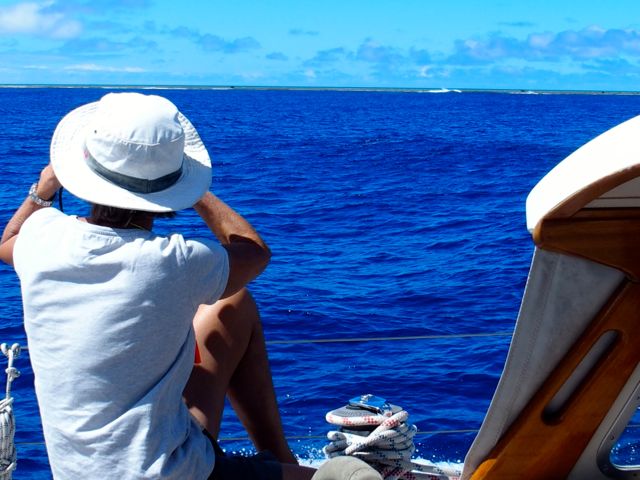 |
| Looking for the pass into N. Minerva reef |
 |
| We anchor a respectable distance from State of Mind |
 |
| Walkie talkie radio headsets aka marriage savers .... as good as their word |
 |
| Low tide at Minerva (and below) |


 |
| Reef combing - Brenda and Diana |

 |
| The brave and foolhardy spear fish on the ocean side of the reef |
 |
| Parrot fish for dinner? |
 |
| The crew of Penn Station on the reef |
 |
| We've looked at clouds from all sides now - the squalls circulate |
 |
| More reef life (and below) |
 |
| Clams come in all colours |

 |
| Rod and Brenda with State of Mind in the background |
When we arrived in N. Minerva, there was just State of Mind (sailed by Rod and Brenda) anchored. Penn Station (with Wiki, and Nikki, and a web-footed diver called Red on board) came in soon after us, and for a few days, there were just the three of us. But by the end of the week, 10 yachts were in N. Minerva, champing at the bit to be on their way.
 |
| La Belle Epoque is a true voyaging vessel |
 |
| That sarong - given to me in Tahiti when I was 16, still good for tropical wear. |
 |
| She who tires of sunsets, tires of life....(adapted from S. Johnson) |
The weather conference on Enki on the final morning was something to behold. Everyone brought their ideas about the gribs. Some boats were taking instruction from MetBob (Bob McDavitt), most were tuning into Gulf Harbour radio for David's weather discussion. But in the end, every skipper has to make his/her own call.
 |
| Our daily life - the radio scheds |
 |
| Boys, focus on weather - if you can (and below) |

Several other boats chose to leave Minerva on the same afternoon we did, most of them bound for Opua. We tied up at Marsden Cove marina's quarantine dock about 12 hours after the speedy State of Mind. Some boats slower than us got caught out badly by the low and had to sail west. They didn't expect to make landfall until Sunday. We felt most keenly for Jan, a single-hander sailing Phoebe, a yellow slip of a yacht (27 feet). We very quickly lost contact with him because he has no SSB radio and cannot check into either radio nets. Nor can he download weather gribs. Jan has sailed his boat from Germany via Patagonia. We shouldn't be worried about him, but you can't help it - he's young enough to be our son.
 |
| Phoebe weighs 2 tons vs Enki's 20 tons |
Some of the cruisers coming into New Zealand now will stay around for the summer, and we may cross paths with them in January and February. Some are selling their boats, others are putting their boats into marinas or onto the hard and going back to the US or Europe to see their families. Then next May, there will be another migration out of New Zealand back to the tropics. That's the pattern known as the cruising season.
 |
| Alex on deck duty - every boat needs a strongman |


We don't know what Enki's next chapter will be, but it seems reasonable for now to assume that this is where we part company from the fleet. We'll keep in touch with some, lose touch with most, but we won't ever forget how interesting this group of people are. From the true adventurers (we count among those Mike and Alisa on Galactic, but there are others we passed along the way including La Belle Epoque, anchored next to us at N. Minerva) to the merely adventurous like ourselves, the crew of every cruising boat has a story.
 |
| Enki II at rest at Marsden Cove Marina |
We'll keep feeding you tasty snippets of nautical-flavoured news for as long as this beautiful boat is part of our life.


