Showing posts with label ancient ruins (Greece). Show all posts

Sunday, 10 August 2014

August/us

Mainland anchorage called O. Vatha, opposite Levkas 

August is crazy time. Special conditions apply. Everyone knows this. Sanity demands that you park your boat in a marina, damn the cost, and wait out these four weeks somewhere cool and grey.  I've dreamed of Ireland in August, or Wales perhaps. Brittany wouldn't be bad either.

Caught napping


This is our third August in the Med, and perhaps our last. We know now that lots of European cruisers don't stay with their boats in August. We've met them at Gouvia marina, handing over a month's berthing fees, charged at high season rates. No regrets. They'll be back to sail again in September when the heat is less gruelling and the crowds are starting to thin.

Dakos salad - rusk, tomato, feta

A long cool espresso - called freddo 


Then there's frozen yoghurt...


On Enki, we take August a day at a time. We travel slowly and at anchor, when the temperature climbs, we pull out the Big Awning. The awning (designed by Alex) supplements the bimini and  gives us shade over the entire cockpit and the aft deck. How lovely to sit in the bean bag, your whole body in shade, a light wind cooling your skin and to read, say, Henry Miller or Proust or Martin Cruz Smith (now, you guess who belongs to which book). Every so often you feel the need to slip into the water. It's clear and cool, with a warm layer on the top by evening. By then it's time for beer and Scrabble.

The wondrous awning


Brew of choice

Camera of choice

There was one more ruin we wanted to see before we left Greece, even though it's August. About seven nautical miles north of Levkas is Preveza, with its busy charter airport and boatyards called Cleopatra and Aktion. It sits at the entrance to the gulf the Romans called Actium, and a short distance to the north of the town are the ruins of Nikopolis. Nikopolis was the city built by the young Roman general Octavian (who is better known as Augustus) after he trounced the much larger fleet of Mark Anthony and his girlfriend Cleopatra  in 31 BC in the gulf of Actium.

The winner writes history

We came down from Corfu on a day which promised breeze and only sporadically delivered, and by 8.30 pm, just as the moon was coming up, were anchored in the shallow bay around from the Preveza town quay. After dinner I crouched on the companionway steps while Alex and Claudia did the dishes  and read out loud to them from Eric Newby's book On the Shores of the Mediterranean. Newby wrote a very nice chapter about visiting marshy, mosquito-ridden Preveza in which he imagined the battle of Actium - which changed the course of the Roman empire.  Neither Preveza nor Mark Antony's troubles had much appeal to his wife Wanda, it seems.

Claudia walks the wall of Nikopolis
I don't think Claudia quite saw the need to go to Nikopolis either, but like Wanda, she is game. We were off the boat early, and on site by 10 am. The heat at that hour was manageable. We would have perhaps been wise to have kept the taxi driver loitering, spent half an hour admiring the exquisite Byzantine mosaic floors which are all that remain of early Christian churches built by cashed-up bishops during the Nikopolis's second period of prosperity and then got our bodies back to the boat. But instead we believed the taxi driver's casual advice that there were "lots of taxis and buses" passing by on that road, and chose to walk on around the walls to the small theatre (Odeon) and after that, follow a dirt road past the necropolis, duck through a corn field and head towards the large theatre. From there, we said, we'd take a taxi or bus to the museum, about 3 km back towards Preveza.

Glorious frescoes from 6th century AD approx


Nikopolis Odeon - small theatre - close to restored

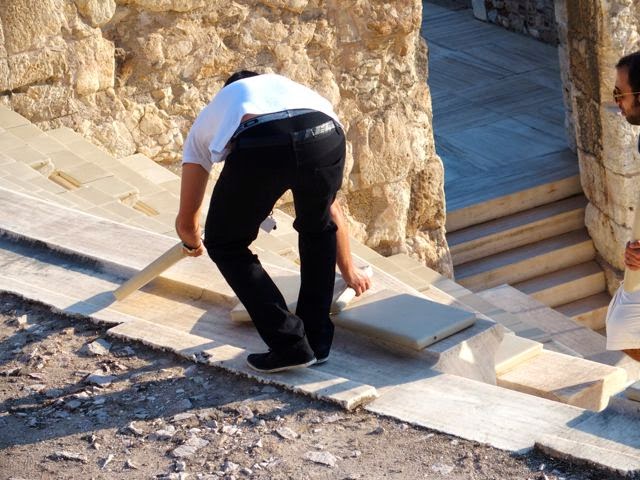
Men at work on the Odeon (and below)


There were no taxis or buses.

Country dwellers

Short cut from the necropolis to the main road

We waited in a shady roadside cafe until the situation became obvious. Then we walked to the museum.

Card games at the crossroads cafe


Now, a museum is somewhere I'll always give the benefit of the doubt. But as we were walking - and there was no footpath, just a very narrow verge and a white line between us and the on-coming traffic  - I wondered what kind of archeological museum would be so far from the site. There's actually not a lot of Octavian's Nikopolis left to see, and I had a sinking feeling that the same might be the case at the museum, should it even be open.

Masterpiece of the Nikopolis museum
Greece does this to you though. It lets you down, and then boom, SURPRISE. There it was, a few hundred metres from the Lidl supermarket, on a stretch of double-carriage road you might kindly call light industrial - a new air-conditioned Euromoney museum with a carpark and foyer built to cater for coach loads of Nikopolis tourists.

They weren't there. Just us, and a bit later, an Indian family wandered in. Everyone else, I guess, was in the water.


Nikopolis was a big and pretty important trading centre but Visigoths and vandals and wars have reduced most of it to rubble. The museum curators have done a lot with very little. Sometimes a little is enough. One great marble bas relief, an elaborately carved sarcophagus (Assos, the perfect post-card harbour we saw on Cephalonia, was a centre of excellent coffin-making), a pile of silver coins, a few amphora, some glass phials and gold leaf, a bust with her nose bashed in, stone tablets (stelae) with proclamations chiseled letter by letter. The ancient roll call is by now very familiar to us. But still we find ourselves gazing intently into each cabinet, comparing and admiring and adding from each museum more "treasure" to our mental collection of ancient beauties.


We're now looking ahead at weather coming across the Ionian, wanting a bit of wind, preferably from the north, to sail to the east coast of Sicily. We take with us from Greece a new and successfully installed 4kg Candy washing machine.

Now that was a hot job.

You had to be there

It can be done! 


Wednesday, 25 June 2014

Delphi and destinations

There's a sense of no return for us in going westwards through the Corinth Canal.


Looking into the Saronic gulf, from the end of the Corinth Canal quay


Business beyond the canal

The canal is opened by submerging the road bridge

Follow the boat in front - and keep moving

The exit 

As we motored out into the gulf of Corinth, we marvelled that it had taken us this long to make for Delphi. At various times we could have done with a quiet word from the oracle, but perhaps no more so than now.

The valley leading from Itea (in distance) up to Delphi


The Athenian treasury (restoration) at Delphi, looking east

Temple of Apollo 

We'd often talked of flying to Greece in the winter months, of seeing Delphi without the heat and the crowds. But in the end we'd chosen to go elsewhere. I'm glad we finally made our approach from the water, escorted into the port of Itea by dolphins. That beats arriving by rental car any day.


The theatre at Delphi, looking towards the temple of Apollo
Delphi is one of those Big Places you can't really have to yourself anyway. It belongs to the world - the ancient Greeks believed it was the centre of the world. It's still a magnet for those seeking self-enlightenment, but the pilgrims who now make their way up to the mountain sanctuary by tour bus need to be told why they're there, and what they've come to see. Mass cultural tourism doesn't persuade me. I suspect it offers more benefits to those who sell product than to those who buy. But perhaps I'm judging others by my own pitiful powers of concentration - I can never listen to a tour guide for more than a few minutes without my brain slipping into some kind of sleep mode.


Museum pieces at Delphi (and below)


Delphi is the last of the ruins, at least until we get to Sicily. We've missed so much in Greece. I understand this even more acutely because I've just finished reading a biography of the 19th century archeological impresario Henry Schliemann. He dug up Mycenae on the Peloponnese, but it's for excavating Troy and its gold that he's mostly remembered. I stumbled across The Lost Treasures of Troy, by Caroline Moorehead, in a second-hand bookshop in Datca, a town better known for its almonds, olive oil and potatoes than as a literary trove. But believe me, finding such a shop in provincial Turkey was akin to unearthing gold.

Apollo statue from Delphi


The town of Itea is quiet in the late afternoon. The summer heat has kicked in and people take the siesta seriously. But today there's an extra reason for catching up on a bit of sleep. A lot of people were up very late last night watching the World Cup game between Greece and Ivory Coast. The blaring of car horns and whoosh of sky rockets way after midnight let us know that Greece had won.

Bus station on main street Itea

There's a hot southeasterly wind pushing us around on the dock. It'd be nice if it stuck around tomorrow. Typically, the wind in the gulfs of Corinth and Patras comes from the west, and you're up against it if you're pushing out towards the Ionian sea. That's our general direction, but we have a lot of our mind at the moment, anxieties generated from home.  We're not sure how far we want to travel and in what time frame. To keep things simple, we think we'll stick around in the Ionian longer than planned. No hardship.

Phone call from Delphi to Sydney


Wednesday, 18 June 2014

Cross purposes

The anchorage on Serifos is far below the old town


I left you in the middle of the Aegean, mumbling something about unstable systems.  We've moved further west, we're down one crew as of yesterday and there's a smattering of foreign attitude on my computer keyboard (alphas, betas, epsilons and the like, of which more later) - but most surprisingly, the air is yet to settle into summer predictability.

Greece vs Spain


I suggested to Freddy that he add "Aegean crossing, east to west" to his CV.  Surely, I reckoned, it would count for something in the corporate jostle...near enough to a Tough Mudder? He will have his own take on that, but when he jumped ship yesterday morning, bound for Turin, his own mother was anything but tough. A real cry baby.

Back on the road

Our route from Naxos to Athens was pretty direct, via Serifos and Poros, and though you wouldn't know it from the inclination of the grinder in the photo below, we had some good fast sailing with moderate to strong winds coming out of the north. A very poor showing on the part of the Greek dolphins however, with only one sighting the whole way across.

Freddy flat out

Enki tracking nicely towards Poros

In Poros, we tied up alongside on a stretch of public dock which, in a de facto fashion, is the preserve of the charter fleet of Greek Sails, but only if they can keep other boats off it. They were happy to have us parked there until Friday when their boats come in, and in this case, our size worked to our advantage. Doing them a favour really (a nice tip from Bunny and Bill of Onset).

Yachts and fishing boats on the Poros dockside

Looking the part is important for some

Navplio, seen from a bastion of the Palamidi fortress
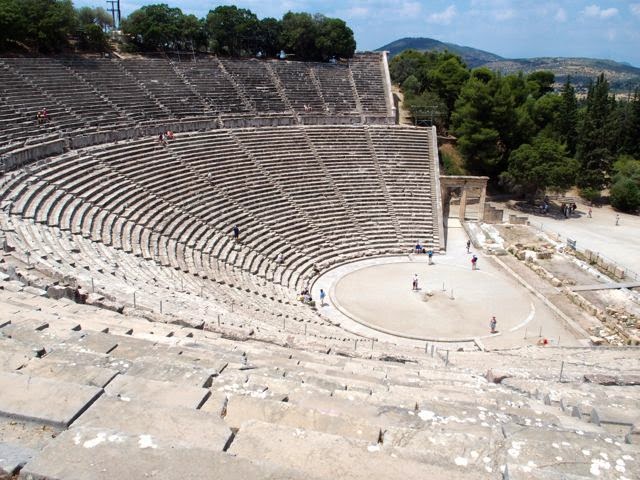
Poros is just across the water from Galatas at the top of the Peloponnese peninsula. This is Mycenean territory. The stupendous citadel of Agamemnon, who commanded the fleet which sailed to Troy to win back Helen, is just over the hills, the same formidable hills which hold the acoustically perfect theatre of Epidavros. I'd set my heart on seeing both these places. Navpoli, where the Venetians built a fortress which runs down the spine of a steep rocky outcrop like scales on an armadillo's back, was a bonus. It's a town for those in the know, I suspect. Freddy, ever alert to a wifi connection, informed us that the director-general of the BBC lives in Navpoli. Who would have thought?

Looking up towards Palamida fortress from the lower Akronafplia fortress
Venetian lion over the gate of Akronafplia fortress 

Epidavros was the pre-eminent healing centre of the ancient world
The athletics stadium at Epidavros and theatre (below) - part of the cure

The Lion Gate at Mycenae 

The entrance to a subterranean acquaduct in Mycenae 

The graves at Mycenae emptied of their treasures (below)

The Poros channel is narrow, but you couldn't pay me to get in that water with its rich notes of raw sewage. To offset the smell, the town has a down-at-heel languorous charm. Ferries, fishing boats, mega-yachts, water taxis.... traffic slides along the channel from early morning till way past midnight. Shades of Venice.

From the aft deck in the Poros channel

On the Acropolis
And so to Athens where, against all odds, we have been caught out by weather. Yes, I know. It seems improbable, this being mid June and Enki being tucked inside Zea marina where nothing, you might imagine, could rattle your peace of mind. But on Sunday, it was close, sticky, hot. Clouds were forming, but we didn't pay them enough attention, and didn't close the ports (the side windows) when we left the boat to go into Athens to the Benaki's Piros annexe (for contemporary art).

That inattention is something we deeply regret. As we came out of the gallery, we heard the thunder.

Resident of the ancient agora of Athens

The storm was vicious and quick. Alex made record time coming back on the train, but the damage was done. Two computers and a phone found swimming on the nav station table and a lot of rainwater in places where it shouldn't go. One computer and the phone were resuscitated, the other computer is confirmed drowned. Ouch.

Drying out


This being Athens, we found a new computer with an English i.e. qwerty keyboard, overlaid with the Greek alphabet. A souvenir. Better than the pictures?

The temple of Hephaestus in the ancient agora


The new Acropolis museum

Before the opera at the Odeon of Herodes Attica (and below)


Old fisherman watching the World Cup  - a regular still at 86

Freddy discusses betting strategy with the bar owner (right)

Without Freddy around we will probably forget to follow the World Cup. He kept us on our toes. Back to cruising, I guess.

Raki o'clock

Ancient sites are an acquired taste (and below)


Here for a moment only