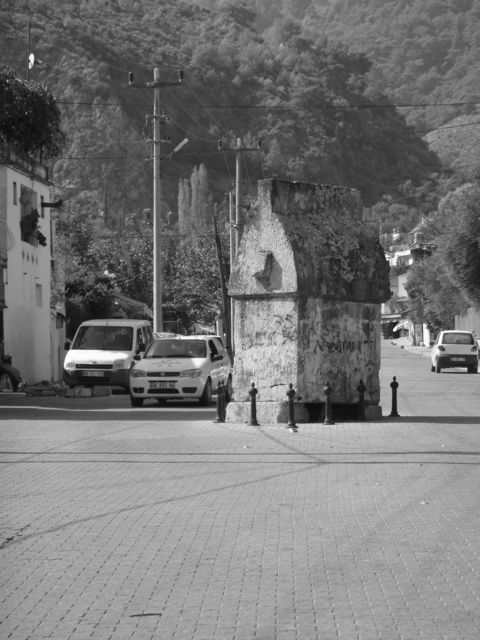
Merhaba. Nasilsiniz? Bir kilo limone lutfen.
 I'm never going to speak Turkish. Not properly. But the novelty of pointing and miming wears off - scratches away at your dignity too - so I'm committed to covering a few basics. Counting is good, up to 10 for sure, and on the way to 100. The niceties are coming along too - hello (merhaba), how are you (nasilsiniz?), I'm fine, and you? (iyiyim, ya siz?), very sorry (cok afedersin), please (lutfen). If that sounds a bit pathetic after nearly three months in the country, try saying thank you a few times in a row - tesekkur ederim (pronounced teshuhkewr edereem). I still can't make it run off the tongue, and it's one of my oldest words. I learned an easier word for thanks this morning at my first Turkish class - sagol (pronounced sowel, like towel). I'll wait to see how it goes down the first time I say it. Sometimes people seem confused when I bring out a new word - goodbye- hosca kal (pronounced hoshcha kal), for example, still occasionally draws startled looks though I know I'm pronouncing it ok. Perhaps its literal meaning is something like 'go well with Allah', or 'I'm missing you already'. Turkish can be like that, I believe. Very flowery.

Speaking of flowers, aren't these tiny wild cyclamens beautiful? They've pushed their way through cracks in the stone seating of Pinara's theatre (seen below through the pines).

We spent the best part of yesterday at Pinara, pretty much on our own. Pinara is the last and most haunting of our ruined Lycian cities. Perhaps I should leave it at that. I'm not much good at descriptive writing. But it's probably useful to know that while Pinara was once of the Big Six in the Lycian league, there's hardly anything left there besides the theatre - and graves. I've always loved cemeteries, but Pinara is in a class of its own.


Like Arykanda, this city was built on a series of terraces below a soaring cliff face. Pinara's cliff faces north east up the Xanthos valley. You approach it from below. The road is rough and winding, and we met goats and an old couple herding them, dressed as if Ataturk's modernisation of Turkey had never happened. At first you see only mass, a lump of solid red rock soaring into the eagle layer. And then you see the holes pecked in the cliff. Tombs, hundreds of them, pigeonholes for the dead, scattered over the rock face. Empty, of course. How did they make them? Why did they put them way up there? I don't know. There's scant information at the site. Pinara is a place which doesn't supply answers. It forces questions, the same ones the Lycians were asking two thousand or more years ago. What comes next, and how should we get ready for it?


At Pinara, where there are fewer remnants of its citizens' temporal life than elsewhere in ancient Lycia, you think constantly of the effort and time that the Lycians spent preparing for life after death. That they hoped the afterlife would be comfortable, I have no doubt. I love the domestic detail on lintel of this tomb. A man sits at a table, his child stands near.

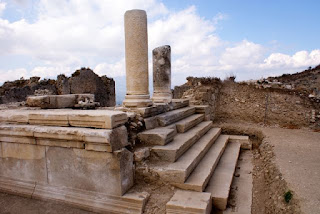
The previous day we were a little further up the Xanthos valley at Tlos, another Lycian city which attracts comparatively few visitors. It's very difficult to convey the scale of these places. The top photo (below) is taken from the agora (marketplace) looking towards the Tlos citadel; the second is taken on top of the citadel; the third from the citadel, and looks beyond the the remains of the agora and towards the theatre in the distance. The lower photo is taken from below the citadel looking down the Xanthos valley.


To wander in such a place with no limit on our time except that which we have imposed on ourselves, to feed our curiosity and to be delighted and awed by what we come across, to accumulate a smidgeon more understanding of the mysterious human condition is, I think, the essence of travel as we want to experience it. We won't, and can't see everything - neither of us are very interested in ticking the boxes. But this summer and autumn in Turkey we've had the joy of meeting a genius civilisation. What's left of it is as beguiling in fragments as it is in more magnificent, complete structures - almost always theatres, as Alex pointed out to me, because they were built in a semi-circle and withstood the upheaval of the earth better than rectangular buildings.


Tlos and Pinara are two or three hours south of Marmaris, so we booked a couple of nights at a Villa Rhapsody, a small hotel/pension in Kayakoy, a strange place just out of Fethiye. Kayakoy is a place tourists come to gawp. I don't know what they see behind the sad eyes and faded blue paint around long gone doors. I overheard the word "eery" a few times. Yes, it's eery, but more than that, Kayakoy (as the Turks called it) is a monument to political stupidity. It's an embarrassment, surely.


Kayakoy used to be called Levissi, and before that, Karmylassos. In other words, it was Greek. In 1923, after the Turkish War of Independence, the Turks hung up their shingle - This is Turkey, keep out or suffer the consequences - coincidentally, today is Turkey's national flag-waving day, and things are no longer as black and white. But back in 1923, the Turks wanted to be Turkish, not multicultural (i.e. so yesterday, so Ottoman) and the Greeks, even though they'd been building towns and cities along the Aegean and Mediterranean coasts forever (ask the Lycians) were considered the ugliest thorn in Turkish flesh and vice versa.

So one of the first things that happened in modern Turkey was the expulsion of all Christians - and to keep things even, the Greeks agreed to do the same to their Muslims. The little people didn't get a say in any of this. It didn't matter who called what home. If you were a Christian and lived inside the borders of what was now agreed to be Turkey, you were told to go "home" to Greece. And vice versa. From Levissi, supposedly 2000 people were extradited "home" to Greece (that's what was on the flyer we were given at the entrance). But someone is fudging the numbers. There are at least 4000 abandoned and pillaged dwellings (a lot of them two or three-storey houses) plus two very large churches left in this town - and a lot has been carted away. The streets were paved. There was running water. This was not a village. It was a big town with decent services. I'd say 20,000 people is more like it. Gone. Packed their bags and told to bugger off to where they came from. Sound familiar?


Turkey is so full of other people. The living and the dead. Right now, the Russians and the Germans, participants in Marmaris International Race Week, jammed against our hull, their cockpit level with ours. We have to rub along with them for the next few days. We have no choice. People in this part of the world accept that - until they don't.
I leave you with a picture of the happy couple. We haven't practised much with the self-timer, so get out your zoom feature if you need more detail - but I assure you we are disintegrating nicely.


Speaking of flowers, aren't these tiny wild cyclamens beautiful? They've pushed their way through cracks in the stone seating of Pinara's theatre (seen below through the pines).

We spent the best part of yesterday at Pinara, pretty much on our own. Pinara is the last and most haunting of our ruined Lycian cities. Perhaps I should leave it at that. I'm not much good at descriptive writing. But it's probably useful to know that while Pinara was once of the Big Six in the Lycian league, there's hardly anything left there besides the theatre - and graves. I've always loved cemeteries, but Pinara is in a class of its own.


Like Arykanda, this city was built on a series of terraces below a soaring cliff face. Pinara's cliff faces north east up the Xanthos valley. You approach it from below. The road is rough and winding, and we met goats and an old couple herding them, dressed as if Ataturk's modernisation of Turkey had never happened. At first you see only mass, a lump of solid red rock soaring into the eagle layer. And then you see the holes pecked in the cliff. Tombs, hundreds of them, pigeonholes for the dead, scattered over the rock face. Empty, of course. How did they make them? Why did they put them way up there? I don't know. There's scant information at the site. Pinara is a place which doesn't supply answers. It forces questions, the same ones the Lycians were asking two thousand or more years ago. What comes next, and how should we get ready for it?
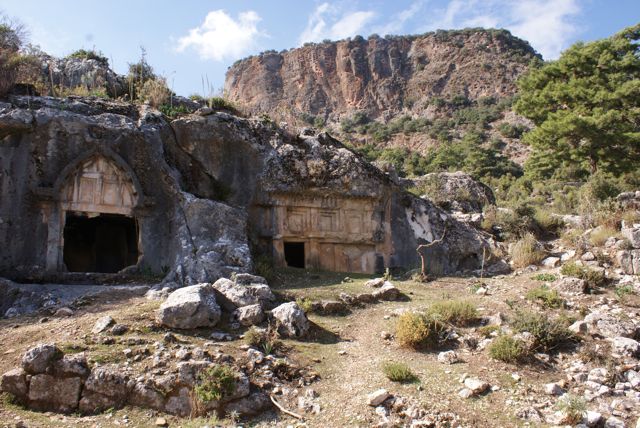


At Pinara, where there are fewer remnants of its citizens' temporal life than elsewhere in ancient Lycia, you think constantly of the effort and time that the Lycians spent preparing for life after death. That they hoped the afterlife would be comfortable, I have no doubt. I love the domestic detail on lintel of this tomb. A man sits at a table, his child stands near.

The previous day we were a little further up the Xanthos valley at Tlos, another Lycian city which attracts comparatively few visitors. It's very difficult to convey the scale of these places. The top photo (below) is taken from the agora (marketplace) looking towards the Tlos citadel; the second is taken on top of the citadel; the third from the citadel, and looks beyond the the remains of the agora and towards the theatre in the distance. The lower photo is taken from below the citadel looking down the Xanthos valley.




Tlos and Pinara are two or three hours south of Marmaris, so we booked a couple of nights at a Villa Rhapsody, a small hotel/pension in Kayakoy, a strange place just out of Fethiye. Kayakoy is a place tourists come to gawp. I don't know what they see behind the sad eyes and faded blue paint around long gone doors. I overheard the word "eery" a few times. Yes, it's eery, but more than that, Kayakoy (as the Turks called it) is a monument to political stupidity. It's an embarrassment, surely.


 |
| Young Turks on the chapel roof - tone deaf? |


Turkey is so full of other people. The living and the dead. Right now, the Russians and the Germans, participants in Marmaris International Race Week, jammed against our hull, their cockpit level with ours. We have to rub along with them for the next few days. We have no choice. People in this part of the world accept that - until they don't.
I leave you with a picture of the happy couple. We haven't practised much with the self-timer, so get out your zoom feature if you need more detail - but I assure you we are disintegrating nicely.