I’ve hauled my kayak up onto
the beach and am trying to pick my way through the underwater rocks to get out
beyond the small breakers for a swim. A
couple of young guys shout for my attention. “Over here, madam, it’s clear over
here.”
 |
| The tiny museum at Taiohae |
They’re bobbing about in the
warm water, chatting like women, with a chubby girl child propped up between
them. The shy one is a tattooist by trade (they puff out their chests and lift
their legs to show me their tattoos,
and I tell them that for the
first time in my life I’m tempted. … Marquesan tattoos are so fine). The
talkative one is a grower. Coconuts, animals.
We’ve taken Enki right around
Nuku Hiva by now, and are back Taiohae Bay for the weekend so I can picture the
terrain he’s farming in the northwest. It’s
drier, and far less mountainous that the rest of the island. That’s where the tiny airport is. So much of Nuku Hiva is covered in thick
vegetation, and the mountains are close to vertical.
 |
| Hatiheu bay on the north coast of Nuku Hiva |
 |
| The north coast of Nuku Hiva from the water (and below) |
 |
| Once were warrios |
We talk about rugby, and how
the French didn’t bring the game with the oval ball to the Marquesas. More’s the pity, they say. Here they play soccer. They also compete
fiercely in pirogues (outrigger canoes).
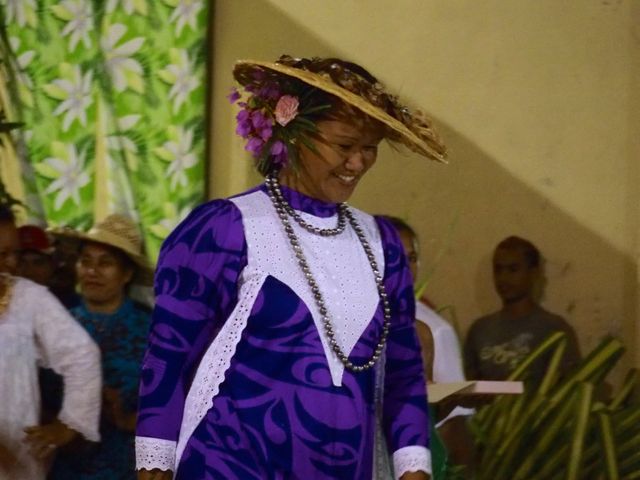
And they dance. The dance competition begins that night. July is a month of festivities, when the would-be
warriors put on their foliage and boar’s teeth necklaces, the girls let their
hair down and roll their hips, and the big drums pound out a beat to make your
blood run – or freeze, depending on which way your imagination leans.
 |
| Saturday night dance competition at Taiohae Bay (and below) |
They’re anything but scary on
a sunny Saturday afternnon at the beach, these Marquesan boys, and they warn me
in all seriousness to be careful in Papeete, that it’s full of thieves, and
dangerous at night. Tahiti is the big French Polynesian smoke. It’s where kids
from the Marquesas have to go if they want to finish their high school
years. It’s where people get into
trouble, if they’re going to get into trouble. Here, in the metropolis of
Taiohae with its 2800 inhabitants, there’s
always someone who knows someone watching you.
 |
| Foreshore of Taiohae Bay |
 |
| Hanging out on the dock (and below) |
 |
| Vege stall outside a general store |
 |
| Snack Vaeaki on the dock is the cruisers' hangout |
Last night at the dancing, we
bumped into Monette, who had fed us lunch after the Daniel’s Bay waterfall
walk. She was eating at the “restaurant” built especially for July, on the side of the dance hall – her
daughter’s restaurant, her grand-daughter was our waitress, and another
grand-daughter had won the Miss July contest we’d sat through the previous
evening. She kept pointing out more of
her family to me.
 |
| Taiohae Bay anchorage |
Before we came back “in” to
Taiohae, we’d anchored off the village of Taipivai in Controller’s Bay (whoever
– French or English - had control of the heights of this three-fingered bay
could wipe out their enemy in the battle between the colonizing powers for
these islands. The French obviously won).
 |
| Controller's Bay from the heights |
 |
| Enki enters Controller's Bay in less than optimal conditions |
 |
| The modern marae at Taipivae - the thatch is plastic |
When there was enough water
to clear the sandbar, we took the dinghy
up the river to Taipivai, through the lagoon which dries at low tide and under
a 240 volt power line slung breathtakingly low from the village side of the
river to the plantation side. Houses, school, church, clinic, marae, soccer field, general stores are strung out along a concrete road which runs up into the
valley. Off the road and high above the river,
are some ancient tikis, the only ones left on Nuku Hiva.
 |
| Wood carving in the church at Taipivae (and below) |
 |
| The Marquesan cross |
We asked the way of a group
of women sitting outside their house near where we thought the track might
start. They pointed in its general
direction. They couldn’t tell us how long it might take, because they’d never
been “up there”.
 |
| Up the valley from Taipivae village (and below) |
 |
| The old tikis up the Taipivae valley (and below) |
 |
| This is how he spent his birthday |
On the way down, we thanked
them. They weren’t curious about us or
the old stone gods.
 |
| Coming back down the Taipivae river on the high tide (and below) |
After my swim with the young
men, I walked along the beach where families were picknicking. At the end of
the beach, a mother and her teenage daughter were sitting in the shade, making a couronne
(crown) out of a bag of fresh flowers and herbs. The girl. Elora, was to wear
it to the festivities that night. The
mother and I talked a bit, and when I left them, Elora shyly offered me two
firm mangoes from a plastic bag. I had nothing with me to offer her in return. They waved me away with smiles.
 |
| Breadfruit |
I looked out for Elora at the
dancing but couldn’t see her. I looked again at the cathedral this morning.
There was a big crowd there for an 8 am sung service. The drums and conch shell
of the previous night – the instrumentation of a pagan religion – had no place
here. Four acoustic guitarists seat amongst the congregation provided the only
accompaniament. The music wasn’t complicated – mostly sung in unison –and as
our new friend Martha, from the NZ-flagged yacht Silver Fern, pointed out,
everyone had perfect pitch.
 |
| Cathedral at Taiohae during the week (below) |
 |
| The cathedral on Sunday morning after the service (and below) |
The liturgy was in Marquesan,
not French. I don’t know why I was
surprised. Only the sermon was delivered
entirely in French, and though I followed the words coming out of the little
French bishop’s mouth, the sense of them went in one ear and out the
other. The transvestite sitting to my
left squeezed past me to take communion, so perhaps the bishop found his
target.