Showing posts with label ancient ruins (Turkey). Show all posts

Sunday, 9 February 2014

The long haul

I know people do it all the time, but how amazing is flying? It beats just about anything else I can think of that we do for sheer improbability. One morning you're catching the tram across the Galata bridge in Istanbul, and 20-something hours later you're bedding down at a friend's house in Sydney. Life-changing.


I've just read a BBC Point of View by Adam Gopnik (who usually writes for the New Yorker) which nails this feeling of wonder I have so neatly. Everyone these days is besotted by advances in information technology but they're missing the point, he says. All the big revolutions in modern times have involved transportation more than information. It matters more to shift a human body speedily than to send screeds of tweets, in other words. Couldn't agree more.


Moving along, literally. We've jumped hemispheres, swapped winter for summer, and are chasing food along a kitchen bench as long as our boat is wide. We are parents again, and in a very limited way thus far (as expected), grandparents. Little Louis has more pressing issues than getting to know family. Give him time.


It seems a shame to completely bypass the two days we spent in Istanbul before we got on the plane which brought us safely over the Middle East to the fabled summer city where girls and cockatoos equally are screamers, have an eye for glitter and love a drink by the rooftop pool. So here's a sample of Alex's pictures.


It's unlikely we'll be in Istanbul again, except in transit. I think of it now as one of my favourite cities. I know that Istanbulites (as they call themselves) say everything's changed, that Turkish PM Erdogan and his AKP party have wrecked it with their progress at any cost agenda, and I get their anguish. We changed hotels after the first of our three nights in Karakoy (the neighbourhood on the water, on the Galata Tower side of the Golden Horn) because the monstrous machine knocking down a building about 50 metres from our window didn't stop work until 2.30 am. That's how it goes in Turkey these days. Rush rush rush. Before someone stops you doing what you want to do.


Inside the Rusten Pasha mosque (and below)


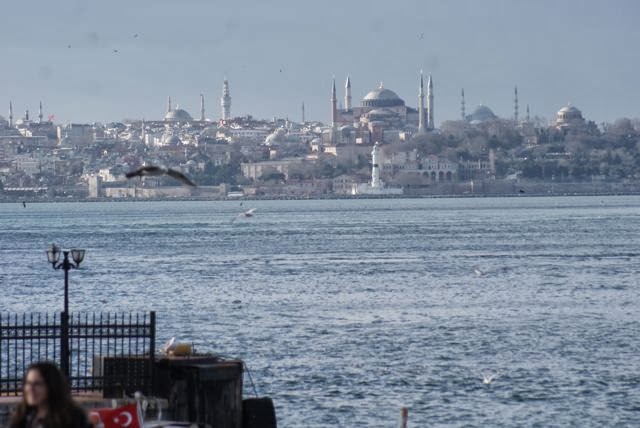
However, there is a sublimity in and about Istanbul that I hope is immune to progress in anyone's lifetime. Start with the skyline above Sultanahmet and the glint on the water of the Golden Horn, the endless variations of blue glazed tiles in the mosques (like this one just beside the Grand Bazaar, called in Rustem Pasha mosque) and in the pavilions of Topkapi palace, the black-coated rivers which pour down Istiklal way into the night, the shoulder-to-shoulder fishermen on the Galata bridge, the tea-waiters on the ferry across to Kadikoy on the Asian side, the food at Ciya Sofrasi. Remember, we came from Berlin where (believe it or not) we struggled to find a restaurant selling schnitzel, Alex's favourite. Berlin is so cosmopolitan. Istanbul is not. It is Turkish. Very Turkish. For better, and for worse. 

As a postscript, I'm adding one last ruin (of course).  We did get away again in the week before we left Marmaris, driving with our Canadian friends Dale and Joanne north to Aphrodisias which in many ways is as impressive a site as Ephesus. It's a bit out of the way though, so we had it mostly to ourselves. You can only dream about a day like that at Ephesus.


The Aphrodisias stadium 

....and theatre

...and southern agora, which featured a stupendously long oval "pond"

Aphrodisias lies in a lush basin at 600 m above sea level. Over it looms a mountain which at this time of year is dusted with snow. The city must have been dazzling in its heyday with its huge stadium (which seated 30,000), temple to Aphrodite, theatres, agoras, baths - all the usual accoutrements of a Greek-inspired city which the Romans then took to another level. Aphrodisias was famous in its time for the quality of its marble and produced a lot of sculpture, much of which is still in situ, or at least, in the museum on the site.


I thought of Aphodisias when we were in the Pergamon museum in Berlin. As well as the Grand Altar of Pergamon, the Germans nabbed a massive gate from the city of Miletus which now has very little to show besides one of antiquity's biggest theatres. The Miletus gate has been rebuilt, just as this monumental gate in Aphrodisais was. But what a difference between the two. The Miletus gate is splendid in every way, but it's like great bear behind bars, much diminished by its captivity.

The Miletus gateway at the Pergamon museum in Berlin

Remains of an elaborate one-off structure known as the Sebasteion

The monumental gate at Aphrodisias

What's left of the temple of Aphrodite
The Aphrodisais gate stands in a green field, and in the late afternoon light, against a bright blue and steel-grey sky, its intricately-sculpted columns and friezes turned a luminous buttery yellow. The archeological model of Aphrodisais suggests that this gate, called the tetrapylon, was just a small thing compared to the Temple of Aphrodite to which it provided an entrance. Some of the temple's columns still stand, or have been restored to standing position, and they too turned gold in the sun. Until recently, peasants tilled their fields around these columns, taking their presence in the landscape for granted. And why not? Yet so much has gone which is why you tend to forgive the German looters (and the Brits who were equally opportunistic) for spiriting away Turkey's heritage. Who knows how this story ends, but Kenan Erim, the archeologist who got excavations underway at Aphrodisais in the early 1960s and who is buried in the green field by the tetrapylon, is Turkish. That's progress too.  


Saturday, 18 January 2014

Winter wrap

We've begun discussing routes for the next cruising season, or should I say seasons, because once we leave Turkey in May we'll keep going. No more winter hiatuses.

Leafless in Labranda

This is a good thing. My brain has slowed down in an alarming way.
"Hope the marina isn't getting too boring," Bridget writes.
I tell her no.
And then I wonder if some kind of marina rot hasn't set in because there are many days when I am happy here, when it's enough to make a pot of soup, bike to the bakery (so much good bread in Turkey once you know where to look), sit in the bright light of the cockpit stitching my tapestry, trade village news, read a book and, of late, do a bit of yoga.
Alex's days are a variation of the above, though they appear more productive because they involve pulling apart whatever section of the boat attracts his interest at the time. After last night's skippers' "de-stress" meeting at Yacht Marine, when one of our number talked us through a disaster scenario titled How NOT to cross the Atlantic in 31 days, I ought to be more grateful for every hour he spends on boat maintenance. Fundamentally though, Alex is keeping himself amused until the season changes. Just as I am.

Early spring bulb - a wild anemone - at Iassos

Boat girl's bag - crochet and recycled bottle-tops
It's a quaint, small life we lead here, mellow to the point of almost turning. It's not for everyone, and I understand why the vast majority of people who cruise in the Med don't even consider staying with their boats over winter. Those of us who do each have our own story. Alex and I are further from home than anyone else here, but distance doesn't seem to matter much in terms of the decisions people make about whether to go or stay. We know French and British liveaboards who haven't been home for years. Americans too. As far as they're concerned, they ARE home, on their boat. Whatever they've left behind can stay behind.

For a brief moment, we considered staying the whole winter in Marmaris on board Enki. We would break it up with a few trips, and save a whole lot of money even so. But things changed in a heartbeat - literally - when Alex learned that he was about to become a grandfather, for the first time. Baby Nemeth is overdue by a couple of days now, so we're checking our email a lot.

We'll be back in Sydney soon after the birth. We leave Marmaris at the end of January, and we'll be gone two months. On the way home, we're diverting for a few days to Berlin. We'd like to see the rest of Pergamon, the parts which the German archeologists hauled away and installed on Berlin's Museum Island. Alex hasn't been to Berlin since the Wall came down. I was last there in 2006, with Sabina. I'd like Alex to see the Memorial to the Murdered Jews of Europe. It changed her life, and in a much smaller way, mine too.

Perhaps before we pack up here, we'll manage one more day trip out of town.  Last week we were in Bodrum to visit friends Jane and Dave and on our way home - yes, Enki is home too - we stopped by a couple of lesser-visited ancient sites. Both offered revelations of a kind.

Grazing rights at Iassos

The council debating chamber at Iassos, with agora behind

The floor was beautiful in its day

The agora of Iassos (above), at the end of the fishy-green Gulluk gulf, was so much more idyllic than we could have imagined. We'd anchored off the village in August but left in disgust without venturing ashore.

On top of Labranda's highest temple


The grand staircase at Labranda

The riven rock, with spring below
At Labranda, a terraced sanctuary built high in the mountains behind the provincial town of Milas (ancient Mylassa), we found a wide set of royal steps to rival any in Rome, and a vast expanse of temples to Zeus. The attraction of the place is obvious -  a hanging rock, split in two as if by a sky god. A spring pushes out from the bottom of the rock. Further up the hillside, more massive rocks which make for natural fortifications.

Apparently, people have been coming to Labranda to worship their gods for thousands of years. Most of what we saw was built in the 4th century BC by the brothers Mausolus and Idreus, who belonged to a phenomenally wealthy Carian dynasty which governed over these parts on behalf of the Persians. When Mausolus died, his widow (and sister) built him a monumental tomb which was known as the Mausoleum. It has long since been destroyed, but words, it turns out, are more durable than stones.


Tuesday, 24 September 2013

Expedition to Antalya

In other parts of the nautical world, people are sick with anxiety. Emails from home have become incoherent. Our high-level contacts in the America's Cup Kiwi support team are sleep-deprived and totally stressed out. We sympathise, and hope Dean Barker will put them out of their misery long before this post is fully digested. Then our dear friends can get back on the water themselves.

Even the calmest of anchorages is ruffled by 30 knots
No scoreboard is being kept where we are, though a surprising number of on-the-water days have been cancelled due to high winds. Nothing that a hire car and last-minute hotel bookings can't take care of. We are, if nothing else, adaptable.

Minyon hotel in Kaleici, the old part of Antalya

You can see Antalya on a fine day from Termessos theatre
We thought we'd seen the best ruins that Turkey has to offer. We've seen a fair few, as you who follow this blog regularly will know (groan). There is a moment when you think you don't need to scramble over another lot of rubble under a relentless sun. Surely there are only so many variations of the theatre and the necropolis, the cistern and the bath-house? Then those canny Greeks and/or Romans reel you in with a beautiful harbour, or a mountain citadel, and confronted with their ingenuity and sophistication, their architectural daring and exquisite attention to detail your only response is an inarticulate "Wow!", or in Alex's case, something more colourful.

South harbour at Phaselis

Roman aqueduct at Phaselis

Agora at Perge
After four days snooping around archeological sites near Antalya (Turkey's major Mediterranean resort city), our "best ancient theatre" category is bursting with strong contenders. Ditto our "most atmospheric ancient city "and our "best ancient agora" categories. Alex was floored by the scale and complexity of Perge, a little east of Antalya. Neither of us had ever heard of Perge, but in its heyday (it had several, both pre- and post-Alexander the Great's blazing a trail through the region in 333 BC) it was a formidable power. Look at the size of this derelict stadium, and imagine it full of togas and chariots, if you can.

Stadium at Perge

One of several bathhouses at Perge

The city gates at Perge

Statue of Alexander the Great, from Perge theatre


Perge bust

Detail from a sarcophargus from Perge
Antalya's museum has a staggering collection of marbles from Perge, not to mention pre-historic and Bronze Age relics. Antalya's harbour, a tight squeeze for modern yachts (we wouldn't contemplate going in), has been in use since Roman times. The old city centre of Kaleici runs down to the harbour, and is littered with fragments of old walls, stumps of ancient towers. The Emperor Hadrian, who certainly got around, left one of his commemorative gates in Antalya, as he did at Phaselis, the beautiful old port just south of Antalya, on the road to Finike.

Antalya bay, looking west

Icecream!

Kaleici house, Antalya


Restoration of seating at Aspendos theatre
From Aspendos (from whence the gladiator above, found in the best preserved Roman theatre in Turkey), we drove along a lush river valley to Beskonak, which now thrives on rafting tourism. We were heading to the ancient city of Selge, far above the river. Freya Stark visited Selge on her epic journey following in Alexander's path. Selge was much harder to get to back in 1957. Freya had to wait around in Antalya for several days until a jeep could be located to take her to where the road starts to climb  at the end of the valley. She says she passed occasional travellers, "riding ponies with a red cloth under a carpet saddle". She also saw camps of nomads in the glades. No-one else. We saw dozens of blow-up rafts, packed with punters in yellow crash helmets, sliding along the deep blue river like woozy cars on a highway.

Rafting down the Kopru Canyon

Roman bridge above the canyon

The road up to Selge

Selge mules
At the end of the valley, Freya transferred to a mule and, with the help of two guides, picked her way up the gorge, which is almost vertical in places, to the village which occupies the site of ancient Selge. It took her three hours. Sixty years later there are earth-moving machines widening the road up the valley and a one-lane sealed road winding for 11 km to the village itself from the Oluk bridge, which the Romans built to span the Kopru Canyon. The village has probably grown with the building of the road, but it is still small  and, by Turkish city standards, primitive. My sense is that we saw much what Freya saw however. The theatre, she wrote,  "was shallow as a saucer and the ploughed fields filled it". Its entrance is now blocked from the village by a pile of massive masonry. The peasant women and children who led us into the theatre told us that an earthquake had toppled the wall  in 1984. They let their cows graze in there.

The ancient theatre sits above the village of Altinkaya

Villagers show us the way into the theatre

Selge theatre


One buyer, many sellers


And then there was the Karain cave, perched above the plain opposite Termessos,  the most dramatic ancient site of them all.  I'm not so keen on caves, but we were in the area and the Karain Cave is the site of the oldest settlement in Turkey. The path up to the mouth of the cave is rough and steep and further than you think. "Is it worth it?" a young couple asked us when we arrived back in the carpark. The girl was wearing a headscarf, a full-length white robe (slim cut) and dress shoes. No, I wanted to say, you'll sweat like a pig and possibly break your ankle. "It depends what's in your head," is what I told her.

The path to the Karain cave, and the valley below


The cave has many chambers, lit by a brute sort of lamp. I touched the surface of the Gaudi-esque rock pillars which separate the chambers and it was like a strange new taste - I didn't recognise the sensation on my fingertips. How could rock feel like toughened old skin? People who lived here would have had hands just like mine. Were they afraid of the dark? Crude steps cut by the archeologists into the dimpled mud took us deeper into the mountainside. The people who lived here were very safe. They were probably not comfortable though. How many people would have sheltered here at a time? There is room for hundreds.

Archeologists can say for certain that people lived in the Karain cave continuously for 25,000 years. They display the evidence in the Antalya museum - stone-age adzes and scrapers and sprocket tools and the bones of very large animals - they say that rhinocerous and lions and hippos once roamed across Turkey's plains. They've also found tools in layers of the cave which they date to between 500,000 and 450,0000 BC. We tried to imagine this far back, but it's too much. If only the word awesome were not exhausted of meaning I would use it now. Awe for the enduring capacity of human beings to survive as long as we have.

Clambering at Termessos

Awe too for the people of Termessos who built their city high in the mountains, with sheer rock cliff at back and sides, and defied anyone, even the great Alexander, to dare invade. An earthquake got them in the end. The city is unexcavated so whatever is still standing has been standing for a couple of thousand years without aid. Look at this theatre, will you? It takes first prize in our "best ancient theatre" category, as the judging stands.


The man behind the camera