Sunday, 9 February 2014

The long haul

I know people do it all the time, but how amazing is flying? It beats just about anything else I can think of that we do for sheer improbability. One morning you're catching the tram across the Galata bridge in Istanbul, and 20-something hours later you're bedding down at a friend's house in Sydney. Life-changing.


I've just read a BBC Point of View by Adam Gopnik (who usually writes for the New Yorker) which nails this feeling of wonder I have so neatly. Everyone these days is besotted by advances in information technology but they're missing the point, he says. All the big revolutions in modern times have involved transportation more than information. It matters more to shift a human body speedily than to send screeds of tweets, in other words. Couldn't agree more.


Moving along, literally. We've jumped hemispheres, swapped winter for summer, and are chasing food along a kitchen bench as long as our boat is wide. We are parents again, and in a very limited way thus far (as expected), grandparents. Little Louis has more pressing issues than getting to know family. Give him time.


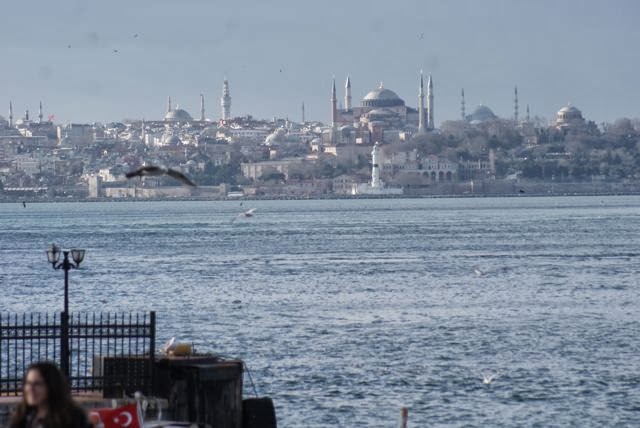
It seems a shame to completely bypass the two days we spent in Istanbul before we got on the plane which brought us safely over the Middle East to the fabled summer city where girls and cockatoos equally are screamers, have an eye for glitter and love a drink by the rooftop pool. So here's a sample of Alex's pictures.


It's unlikely we'll be in Istanbul again, except in transit. I think of it now as one of my favourite cities. I know that Istanbulites (as they call themselves) say everything's changed, that Turkish PM Erdogan and his AKP party have wrecked it with their progress at any cost agenda, and I get their anguish. We changed hotels after the first of our three nights in Karakoy (the neighbourhood on the water, on the Galata Tower side of the Golden Horn) because the monstrous machine knocking down a building about 50 metres from our window didn't stop work until 2.30 am. That's how it goes in Turkey these days. Rush rush rush. Before someone stops you doing what you want to do.


Inside the Rusten Pasha mosque (and below)


However, there is a sublimity in and about Istanbul that I hope is immune to progress in anyone's lifetime. Start with the skyline above Sultanahmet and the glint on the water of the Golden Horn, the endless variations of blue glazed tiles in the mosques (like this one just beside the Grand Bazaar, called in Rustem Pasha mosque) and in the pavilions of Topkapi palace, the black-coated rivers which pour down Istiklal way into the night, the shoulder-to-shoulder fishermen on the Galata bridge, the tea-waiters on the ferry across to Kadikoy on the Asian side, the food at Ciya Sofrasi. Remember, we came from Berlin where (believe it or not) we struggled to find a restaurant selling schnitzel, Alex's favourite. Berlin is so cosmopolitan. Istanbul is not. It is Turkish. Very Turkish. For better, and for worse. 

As a postscript, I'm adding one last ruin (of course).  We did get away again in the week before we left Marmaris, driving with our Canadian friends Dale and Joanne north to Aphrodisias which in many ways is as impressive a site as Ephesus. It's a bit out of the way though, so we had it mostly to ourselves. You can only dream about a day like that at Ephesus.


The Aphrodisias stadium 

....and theatre

...and southern agora, which featured a stupendously long oval "pond"

Aphrodisias lies in a lush basin at 600 m above sea level. Over it looms a mountain which at this time of year is dusted with snow. The city must have been dazzling in its heyday with its huge stadium (which seated 30,000), temple to Aphrodite, theatres, agoras, baths - all the usual accoutrements of a Greek-inspired city which the Romans then took to another level. Aphrodisias was famous in its time for the quality of its marble and produced a lot of sculpture, much of which is still in situ, or at least, in the museum on the site.


I thought of Aphodisias when we were in the Pergamon museum in Berlin. As well as the Grand Altar of Pergamon, the Germans nabbed a massive gate from the city of Miletus which now has very little to show besides one of antiquity's biggest theatres. The Miletus gate has been rebuilt, just as this monumental gate in Aphrodisais was. But what a difference between the two. The Miletus gate is splendid in every way, but it's like great bear behind bars, much diminished by its captivity.

The Miletus gateway at the Pergamon museum in Berlin

Remains of an elaborate one-off structure known as the Sebasteion

The monumental gate at Aphrodisias

What's left of the temple of Aphrodite
The Aphrodisais gate stands in a green field, and in the late afternoon light, against a bright blue and steel-grey sky, its intricately-sculpted columns and friezes turned a luminous buttery yellow. The archeological model of Aphrodisais suggests that this gate, called the tetrapylon, was just a small thing compared to the Temple of Aphrodite to which it provided an entrance. Some of the temple's columns still stand, or have been restored to standing position, and they too turned gold in the sun. Until recently, peasants tilled their fields around these columns, taking their presence in the landscape for granted. And why not? Yet so much has gone which is why you tend to forgive the German looters (and the Brits who were equally opportunistic) for spiriting away Turkey's heritage. Who knows how this story ends, but Kenan Erim, the archeologist who got excavations underway at Aphrodisais in the early 1960s and who is buried in the green field by the tetrapylon, is Turkish. That's progress too.  


Saturday, 1 February 2014

Now we take Berlin

We're like a couple of rabbits who have pushed the self-eject button, fired themselves out of their cosy burrow and now find themselves whirling about in a crazy white wonderland.

One of those imperial types on the perimeter of the Tiergarten
Looking towards Potzdammer Platz, with Berlin Philharmonic hall (yellow)
The Spree all iced up

Warm inside, cold outside


The full story of the rabbits' adventures in Berlin will have to wait, since we are again scampering, leaving this morning for Istanbul where we'll be able to patter around relatively unencumbered by multi-layered thermals. It's been severely cold in Berlin, making the winter we've experienced in Turkey seem downright tropical by comparison.

A last glimpse from Enki's back door before we leave

The breaking news from Berlin, aside from the white noise provided by the wider world's raging and groaning, is that a boy was born! His name, we are told tentatively, is Louis Alexander. His mother is well (as the phrase goes), and his father and grandfather have been exchanging daily emails in a kind of mutual ecstasy, both overwhelmed by this most ordinary and miraculous of human events. We toasted the new arrival with champagne in KaDeWa's new Veuve Cliquot bar - as fine a reason as any to revert to our bad old ways, though our scuffed hiking boots and jeans did rather distinguish us from the fashionable after-work crowd.

For us, this town has been all about the museums. That's what we came for, and given the well-below-zero temperatures, there was no quibbling about the high-brow itinerary. Armed with museum passes (24 euros buys free entry to all state museums, and many others besides, for three days) and travel passes, we were limited only by our physical and mental stamina. You'd have to say that great museums are not for pussies.

The war never really goes away in Berlin - exhibition at the Neue Nationalgalerie

The Memorial to Europe's Murdered Jews
An also-ran (the Altes Museum) on Museum Island

Display wall in the Bauhaus archive

Mies van der Rohe's "new" national gallery, with severe-style church

This guy decorated the palace of the Perisan king Darius
You enter, say, the Neues museum, famous for its exquisitely preserved bust of the Egyptian queen Neferiti, thinking that knowing nothing about Egyptology until this point you'll probably go over the hieroglyphics etc with a light brush and then move onto the Roman and Greek collections in the Altes museum. Oh no! Not a chance.

For what you see in the courtyards of the re-built Neues museum blows open a huge hole in yet another unopened chamber in your mind, and in rush all sorts of questions and the realisation that, given more time, you could get really interested in those 3000 years of continuous civilisation along the Nile river.

There's a ridiculous amount of other people's heritage in Berlin. The gentlemen archeologists of the 19th century were in it for the thrill of the chase as much as anything, I gather. For them, locating the ancient site of Troy and excavating its treasures was as thrilling as the moon landing was for my generation in the 20th century.

How on earth did they bring back all that loot - entire city walls of a desert castle, the front of the Great Altar at Pergamon and big slabs of its monumental frieze, serious-sized fragments of Egyptian burial chambers, the gates of Babylon, for goodness sake?

Part of the Pergamon frieze
They took the front of the temple to Berlin

The so-called Berlin Green Head, carved in 400 BC in the late Egyptian period

Raised hieroglyphics on one of several tombs in the Neues museum

The Ishtar gate,  from King Nebuchadnezzar's Babylon

The roar of Babylon

We've stored away so many images and sounds over these past few days...four centuries of European painting at the Gemaldegalerie, the huge retrospective of Barbara Klemm's photographs at the Martin Gropius Bau, Dvorak's cello concerto, played by Daniel Muller-Schott and the Berlin Philharmonia in that concert hall.

Apartment block on the way to the Bauhaus Archive
The fabulous Sony building roof in Potzdammer place

The elegant Fasenanstrasse, in old West Berlin
Casual Tuesday - free lunchtime concert in the Berlin Phil foyer


And now I must rush, because the bus which will take us to Tegel airport leaves in 20 minutes