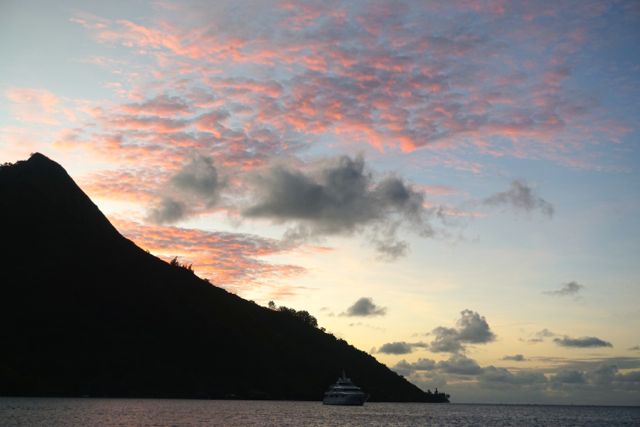
PIX TO BE POSTED AFTER OUR ARRIVAL IN TAHITI - WHICH IS IMMINENT
We've left behind the Paumotu girls with the pearl earrings.
You'd see them in Rotoava, kicking along the road in groups of two or three. One might be carrying a baby. They'd usually be laughing. They'd be wearing shorts and a top, some kind of easy footwear or bare feet, and in their earlobes, lustrous pearl studs. Green or grey, purple or black. Tahitian pearls (or black pearls as they're sometimes called) come in lots of colours. All the girls wore them, just as they all wore their long thick hair twisted into a heavy knot at the back of the neck. Very often they'd have stuck a fresh flower behind the ear, just like the postcards, and yet nothing about them looked contrived.
In my super fine hair, a flower behind the ear doesn't stand a chance, but they could keep a whole flower arrangement in place on their heads. For special occasions, they did - they'd have their hair brushed out, a crown of fresh flowers on top, and around their person, more pearls. Short strands of perfect small pearls for young girls, long strands of outrageously large pearls for the mamas. One of the ladies in the craft tent at Heiva had made up for sale necklaces of tiny bright-orange shells interspersed with black pearls. So Tuamotus.
You get to thinking differently about pearls after you've been floating about in the Fakarava lagoon for a bit, keeping a lookout for the pearl farm buoys and talking to women who know their product. "You don't pay less than 5000 francs for a good pearl," Liza tells us one evening. "Anything less than that is a rubbish pearl." We've met Liza on our first day anchored at the south-eastern tip of Fakarava, and she's reeled us in. We offer no resistance. She's an ample-bosomed, gregarious woman with a throaty laugh, a bon vivant of sorts with keen sense of hospitality and commerce. For a couple of evenings,we sit around the table in her open-sided beach hut with other cruisers, and she feeds us poisson cru, seared tuna, grilled fish (mahi mahi, grouper), chips, rice and big bottles of Hinano beer. We can hardly move afterwards.
After the plates are cleared (a baby pig rustling around under the table nibbling toes was hinting at others waiting for their fair share of the evening's fare), Liza comes out of the kitchen. She's in hostess mode, wearing a loose silky off-the-shoulder above-the-knee dress, her grey-streaked hair down and a dried flower crown completing the outfit. In her ears, the same pearls I noticed earlier in the day when she'd hooked a small bunch of green coconuts down from a very tall palm behind the house, and with a machete, sharpened for the morning's copra work, cut them open for us to drink from. She works hard, does Liza.
She lights up one of Alex's cigarettes and talks. This is why she cooks for us, so she can talk. This could be a lonely spot. Nothing in the way Liza speaks suggests that she is lonely. She has her man Jean (a Morgan Freeman lookalike who spent 17 years in the French Foreign Legion), and further along the beach, a couple of his sisters and their families. She grew up on Toau, a very much smaller and less accessible atoll north of Fakarava and she loves to tell stories about those simpler times. But the only visible light looking out from their house behind the beach bar is a navigational beacon. It's probably near the south pass, which is littered with reefs. The village to the north is 55 km away by boat. When she needs to go shopping, they take their boat up the same channel we came down. It's not always smooth water in the lagoon. Far from it. We foreigners, we transients, are her entertainment, we are the reason she pushed Jean to help her build a restaurant on the beach a couple of years ago. "He could live here alone," she says, "but I like people."
What she has to say about pearls is probably common enough knowledge, but a lot of cruisers passing through the Tuamotus arrive hoping to pick up cheap black pearls. They've heard stories from those who've come through before them. Handfuls of pearls for only XXXXX. And it's true, there are cheap pearls to be bought. But the people in the Tuamotus aren't naive. They're not selling you anything they can't sell somewhere else for a better price. If you've been sold cheap pearls, it's because that's all they've got left to sell you. The pretty ones have already been sent to Tahiti.
The price of black pearls has fallen. That's because too many are being produced too quickly, according to Liza. It used to take two years to grow a pearl, and now it's more like one year before the pearls are brought to market. More pearls, cheaper pearls...and less durable pearls. A pearl which has been left for two years inside the mother-of-pearl shell in the water, growing its beautiful lustre, lasts a lot longer than one left for half that time. "I've had these for 10 years," she says, fingering her own pearls, "and they haven't changed colour."
But we all have a budget, don't we? So we cruisers sail away from the Tuamotus with our 1000 FPF pearls, and likely feel happy with what we've bought. Probably the colour and the lustre of our cheap pearls will fade, but what we're really after is memories, isn't it? Tokens of our passing by there. Everything fades.
In southeast Fakarava, we met a French couple who have one of the most famous names in sailing - Taberlay. Marie was wearing an interesting arrangement of pearls around her neck, which I admired in the dark as we sat around a fire built by the redoubtable beach barbecue team on Silver Fern. In daylight she showed me how her necklace was put together - three pearls, two at the neck and one at the back, serving as a clasp, cleverly held by and strung on very fine Spectra (a synthetic rope stronger than steel). The pearls were originally a gift from a friend, and strung on a natural fibre which had rotted. Marie's husband Patrick, who is a true man of the sea, had re-constructed her necklace using a fibre he had on the boat. It will never rot, and Marie can wear them everyday, just like the girls of Paumotu.
----------
radio email processed by SailMail
for information see:
http://www.sailmail.com