Tuesday, 9 October 2012

Full circle to Fethiye


We had to come back to Fethiye. It was where we would have started our cruising this year had we decided not to buy Enki, but rather opted for Lazy Jacques, a very attractively priced Contest 48 which was in exceptionally good nick. We flew from London into Fethiye's baking heat in June last year and spent a couple of days checking her out from top to tail (photo below).  We almost talked ourselves into her creature comforts - huge cockpit chart-plotter, copious air-conditioning, hyraulic passarelle, gorgeous cocktail cabinet  - and then we backed off. We wanted Enki's hardtop very badly. 


Just the other day, as we were sitting in Fathom Cove, watching thundery-looking clouds rolling off the mountains behind Fethiye, we were talking of that boat, and wondering if anyone had yet bought her (it's still a tough market for sellers) and if so, who. 


Our first "real" rain in four months
Now we know. In Gocek, Alex picked up the October issue of Yachting Monthly and there on p4 under the headline Chay Blyth Becomes a Cruiser! was a photo of his new sailing boat,  the very same Lazy Jacques.  Blyth, for those of you not familiar with the name, is famous as a rip, shit and bust non-stop circumnavigator, a boy racer type. He once rowed across the Atlantic with another paratrooper mate of his. A leisurely cruise around the world with his wife, one reads between the lines, is a concession to his advanced age -  he is 72.  They'll be sailing Lazy Jacques (being renamed Willy Waught) from Turkey to the Canaries next summer. They've signed up for the Atlantic Rally for Cruisers (ARC) in 2013, and are then carrying on across the Pacific with the World ARC, the crowd we tried so hard to avoid in Vanuatu in 2010. Sound like a familiar route? Wonder if we'll try to avoid Sir Chay and Lady Felicity should we cross the ARC's path again,  or if we won't be able to resist the 'hey, we almost bought your boat' pick-up line.

We've also come back to Fethiye to close the Lycian circle. Fethiye is where I first heard the word Lycian. Please don't go away. I'll keep it brief. When we visited last year, we were dazzled by the small local museum's collection of archeological treasures, many of which had been recently excavated from places which we'd never heard of but which we learned were quite near to Fethiye. I remember being astonished to see Lycian coins which were minted in the 5th century BC. There was an amazing block of stone, from somewhere called Letoon, with a proclamation etched on three sides in three different languages - Greek, Persian and Lycian (photo on left). Who were these people? Since then we've made up for lost time in the ruins department, and today we revisited the museum, much wiser about things Lycian, and about why their buried cities are revealing such treasure to teams of Turkish archeologists now that they got the bit between their teeth.


Statue of a Roman emperor, excavated from Tlos in 2011
Fethiye has rock tombs too, but we took little notice of them last time. They're magnficent. Today we climbed up to the biggest of them, built in the 4th century BC by a Lycian king called Amyntas. We think the Fethiye tombs are as, or even more extraordinary than the much more popular tombs in Myra.


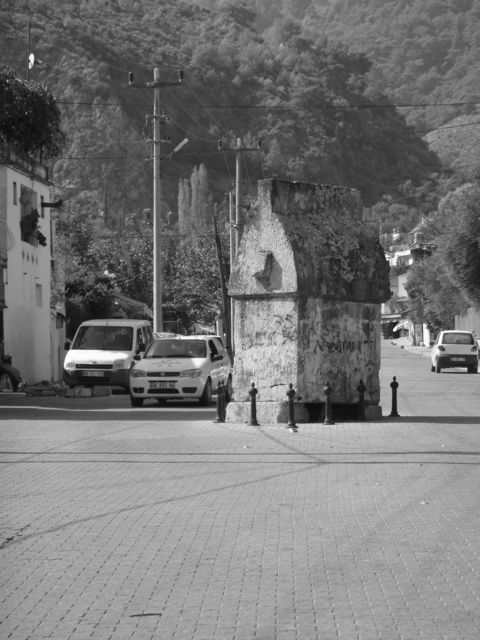
But don't you just love the sarcophagae scattered around the town, like this one which is a kind of traffic island?


Then there are the people, who live their lives around these tombs, and all the other paraphernalia in this town which has had more lives that its plenteous cats.


We like the open-mindedness that we've encountered in Turkey, the co-existence of Efes beer and minarets, of high heels and headscarves, of new money and old ways. There's a resilience, and an elasticity we've found here that perhaps shouldn't surprise us. Things change, but they stay the same - Fethiye is the town that was ancient Telmessos, and also Megri at one time, but was renamed after independence for Turkey's first "aviation martyr", who crashed his plane near Damascus in 1914 trying to fly from Istanbul to Cairo.  A big earthquake flattened the town in 1957, but the status symbol tomb which Amyntas built for his bodily remains in the cliffs hasn't moved, and he's still got the best view in town (the one that opens this post).


Thursday, 4 October 2012

More current affairs


My mother described my previous post about Lycian ruins as a "learned dissertation" from which I gather that she wants me to lighten up, and give her a break from poring over her atlas trying to locate obscure ancient sites. Wish granted.

Speaking of restored ruins, I offer the two items below as evidence of the powerful restorative effects of greatly diminished responsibility and generous doses of sunshine and saltwater...and other pleasures. Scrabble, for instance!


More games in store. I bought a backgammon board, made from olive wood, at the market in Kas. My new friend Suzanne offered to teach me how to play, but then, as boating people are wont to do, she and her husband Brian took their Nordhaven 57 down to Kekova and I'm on my own with Turkey's favourite board game. Alex promises to play. 

We're on the fringes of Gocek bay, a glittering place with more and bigger yachts (by which I also mean the small private "ships" which in the Med are known as yachts) on its flat waters than anywhere we've been so far. And it's supposedly quiet now, being nearly the end of the season.

Gocek is probably Turkey's classiest yachting destination, Turkey's St Tropez, if you like. It sits at the head of a wide gulf which is protected by a rim of blue misty mountains, some of them very high. A chain of islands running north-south down the gulf offers enough interesting anchorages to string out over a week's cruising, without too many miles to cover between breakfast and cocktails. The perfect charter destination, in other words. Plus (and here's the clincher) Gocek is only a half hour's drive from Dalaman airport, compared to Marmaris's hour and a half, which is mightily attractive to those who have more money than time.

The approach to the gulf of Gocek (and Fethiye) from the south


Some people need more room than others

So we're sitting pretty amongst the big boys' toys, kicking up our heels in the clear water for which these anchorages are renowned (they're also very deep, which makes anchoring a bit hairy). We've scraped the barnacles from Enki's waterline, and done the washing. Read the New Yorker. Restful things. Those billowing clouds you can see in the pictures above are a regular feature of the sky now. We keep a close eye on them.

We got caught out the night we left Kas by a thunderstorm we didn't see coming - though we ought to have. Unfortunately, we weren't in a good position to ride it out. The anchorage around from Kalkan became very crowded after we'd arrived, and we found ourselves boxed in by a gulet on one side, and a small charter yacht on the other. Alex took the photo below at about 11 pm, before the storm broke. He had politely (yes, Alex can be polite) suggested to the charter boat skipper that he move his boat, since there was electrical activity around and it was anyone's guess where the squalls would come from. The skipper declined to move his boat then, and declined yet again as the wind became wilder. 


We didn't sleep that night. The sea built up quickly, and we stood watch anxiously as Enki and the charter boat and the gulet moved around their anchors and between our/their lines attached to rocks onshore. The charter boat bounced up and down like a toy in the angry sea, its bow about a metre from our stern at closest, and at one point its anchor chain dropping down right under our boat. Finally, a big squall on the beam flipped our anchor out of the weed and sandy (not good holding) and we dragged onto the gulet - oh, you don't want to know.

By 3.30 am, we had re-anchored much further out in the bay, in 24 metres of water, thankful for a full moon and our powerful new windlass. But we were not happy with that skipper who had given us no way out except to up-anchor. Very rude. He ended the night rafted up to the gulet. Shameful. He couldn't get his anchor up.

The Turkish navy's firing zone included the seven capes
We motored up the coast the next day, away from that bad night. By early afternoon we were scurrying to clear a firing zone. Over and over on VHF 16 the Turkish navy broadcast that it would be using the region between such and such coordinates for firing practice between 1430 and 2000  - the sequestered zone included a big chunk of the coast north of Kalkan, the part known as the seven capes. Bizarre, we thought, watching a naval helicopter buzz straying yachts which obviously didn't have their VHF on. There was a warship on the horizon. The thud of artillery began right on the dot of 1430.

In today's BBC world news I read that the Turkish army began shelling Syrian targets yesterday, Wednesday, after Syrian fire killed five people in a Turkish border town.  Today the Turkish parliament has authorised cross-border action against Syria. Target practice suddenly looks not so frivolous.

Saturday, 29 September 2012

Time to dig a bit deeper

I'm in all sorts of trouble here. Far too much to show and tell. I'll imagine myself at primary school, standing in front of the class, legs trembling, with five minutes to do my talk. The teacher's at the back of the room, tapping her wristwatch...

Back to the wall of the best grave at Arykanda

This has been the week we started to get the hang of Turkey. Not so much modern Turkey, or the easy-going part of it we've come to know over the summer, but its previous incarnations which, now we've been here a while, seem increasingly important to learn something of.

Faces from Myra's past 

Demre's hothouses butt up against the ruins of  ancient Myra
I have a longstanding habit of finding my way into places through books.  Recently I've gone back to Orhan Pamuk, a monumental writer, and not one to underestimate his reader's intelligence. My Name is Red is set in 16th century Istanbul amongst a clique of miniaturist painters - he draws out of that esoteric brew the sharp dynamics which I am beginning to recognise as essentially of this country now called Turkey. Pamuk's books take for granted some knowledge of its glorious and inglorious history. I come up seriously short here.  Thankfully, Louis de Berniere's novel Birds Without Wings, which I mentioned in the previous post as being set in this part of Turkey (somewhere between Letoon and Fethiye, I'm guessing), assumes the reader is an ignoramus and for that reason alone it was enormously useful to read - actually, I couldn't put down my Kindle for several days.

Buried Byzantine church pillar at Olympos

Mosaic fragments in the bush at Olympos

I now have my Ottoman and my Byzantine empires better sorted; I understand a little more about the waves of Persians and Egyptians and Turks (people who came from Central Asia) which displaced the Greeks and Roman occupations on this coast and about why the tide is always out for the Armenians and the Kurds; I know more about how things stand now between Greeks and Turks (Cain and Abel, blood brothers) and about why the Turkish army and the inheritance of Mustafa Kemal 'Ataturk' has such political potency. But mostly, because of what I've read, I feel much more comfortable about being in Turkey as a non-Muslim (non-religious, to be exact). The people who've lived on this south-western region of Anatolia have never have been a homogenous lot. They're very used to rubbing along with 'infidels' and Franks, as the Ottomans used to call western Europeans.

Doorway in Kas

A Lycian king's lion tomb in Kas

Buying grapes and figs on the road in the hills behind Kas

A hundred years ago, before the brutal population exchange which accompanied the birth of the new Turkish state, the population of a town like Kas would have been a gritty mix of Turks (Muslims), Greeks (Christians), Armenians, Jews and drifters from various corners of the vast Ottoman empire. Everyone would have spoken Turkish. Occasionally people would have choked on each other's beliefs and ethnicities, but commerce then, as today, is a marvellous lubricant. I think the closest thing to being an Ottoman today is being American.

Today, Kas has a couple of mosques at least, but no churches I can see. Yet it is mellow, a live and let live kind of town, less indebted to the English tourist trade than its glitzy neighbour Kalkan, and yet open to persuasion. Perhaps this sophisticated new marina we're parked in, with blissfully few other boats around us, will change its character. I'd like to think not.

Texting at the base of the Lion Tomb

Backgammon passes the time in Kas

We came back to Kas a week ago, sporting yet another grievous injury to boating body parts. This time it was the Lewmar V3 windlass which had seized, terminally as we now know, as we were upping anchor in Kekova.  Thank God for electric winches is all I'll say, and spare you rest of the gory details - there have been too many of those already. The good news is that we've been able to buy a replacement in Turkey and it's here on the boat - and with luck, it'll be fitted by the end of the weekend.

While we were waiting for this (bigger V4) windlass to arrive from Istanbul, we did what we'd been planning to do anyway - hired a car to visit more Lycian ruins. Truly, you say, more ruins? Yes. More ruins. And not one site the same as another. All part of the Lycian League which I grow more and more fascinated by. Not just tombs, you see. So much more than tombs, in fact.


Before we set out on our travels through Lycia,  Alex been wondering how it was that he and Jan had missed it when they drove through Turkey nearly 40 years ago on their epic VW Kombi trip from London to Calcutta. "We were young, but we weren't totally uncultured," he said. As the days flipped by however, we realised that, with the possible exception of Myra, these Lycian sites in and beneath the Taurus mountains can't have been on the map back then. Locals would have always known about their ruins, and plundered from them, and perhaps a British explorer had passed that way a century before and plundered yet more and written a scholarly article or two for the Royal Whatever Society. But the money and the knowhow necessary to excavate these magnificent civic structures from the hundred of thousands of metres of silt and rubble under which they've been buried for two millenia has been available to the Turks only quite recently. Work at Patara, for example, didn't get going until the late 1980s, and at Olympos it was much later in about 2005.

Ruins at Olympos are scattered along the river leading to the sea

Roman temple lintel, Olympos


Olympos, despite the seductive name, is not really worth visiting yet. The ruins there are in their "natural" state, choked by vegetation, scattered, hard to piece together with the eye and far from being pieced together by the archeologists. The walk along the river is divine, but not so the seedy hippy strip which feeds into it. It's a long drive from Kas, and the best we could say for the effort we put in is that it was interesting to see the beginning of the excavation process - and then think of Ephesus, and of the treasures which many many decades of hard archeological labour have drawn forth from the earth.

Oops. The teacher is looking at her watch.

For sheer spectacle, Arykanda is the pick of the ruined Lycian cities. It was never as big nor as important as, say, Patara or Xanthos, but both those more famous cities must have envied the grandeur of Arykanda's setting, built as it was over five terraced levels high on a pine-clad mountainside overlooking a river valley and backed up against impregnable cliffs.  Archeological excavations started about 30 years ago and while there are still probably thousands of cubic tonnes of stony earth to barrow away, what's been uncovered so far is precious and marvellous.

Arykanda's amphitheatre is on the 4th of the city's five terraced levels


Arykanda's city hall led off the main town square


A huge bath house with a view

The press and babble of humanity which makes visiting places like Ephesus and Myra a bit of a trial is completely absent at Arykana, which is about 30 km inland from Finike and easy to miss.  Here you meet no touts and there's nothing for sale. There are no blonde Russian babes posing on terraces and tombs for the benefit of their Facebook friends, and no pompous tour guides bossing around their flocks. In fact, we saw almost no-one else at Arykanda during three hours.

The bliss of sitting under a pine tree near the stadium on the highest level, cutting into our tomatoes and bread, watched only by surveyors also on their lunch break.


Running track and seating (stadium) on the top level of Arykanda

In our solitude, and from that height, it was very easy to imagine a city in which people argued and applauded and bathed and shopped and loved until the earth quaked, and those who were left ran away to a place further down the valley.

Watching the boats sail by at Patara

We left the ancient port city of Patara till last, by chance, but that's not a bad way to do it. For the price of admission to the ruins of Patara you also get access to its better known sandy beach, Turkey's longest. There were many more people at Patara for the beach than the ruins, but it's hot, so very hot - still. We hired sunbeds under an umbrella (for the first and last time) and knew for certain that if you're from Australia or New Zealand you can't lie on a beach in Europe without thinking about home.

Roman arches at the entry to Patara


Patara was a port city built around the estuary of the Xanthos river, said by Horace and Virgil to be the birthplace of the god Apollo (??). The Lycians are thought to have moved there from Turkey's interior in the Bronze Age (3000 BC), but the height of Patara's influence was between about 200 BC and 300 AD when it was the capital of the Lycian League.  By the 7th century, by which time the Arabs had over-run the region, it was losing its clout. Its harbour had silted up, which is always a bad look for a port city. Patara is a now a swathe of wetlands (nesting for turtles) and sandy expanses covered in thorny scrub and olive trees which support a few sheep and goats. It is still pushing up ancient stones of incalculable significance.


Patara's 10,000-seat amphitheatre was even bigger than Myra's, which was bigger than Arykanda's. This was the big smoke, with big marketplaces, baths, temples (this was Apollo's town), etc. All the usual urban stuff. The most astonishing structure at Patara though is its restored assembly hall, or parliament building. From a distance the pale new stone which has been used to supplement the old stone jars the eye, offends it actually. What were they thinking?

Patara's reconstructed Lycian assembly hall, opened in 2011


Well, they, that is the Turkish government which funded the project to the tune of 6 million TL, were thinking this: "What makes this structure so special is that it once housed the national government of the Lycian League, a democratic government system setting a perfect example for all modern governmental systems, especially the Constitution of the United States of America." You need to get into it a bit, but the argument is made that the Lycian League, which first came together in 205 BC, negotiated autonomy from the Romans in 167 BC and lasted until the 3rd century AD, was the world's first recorded example of representative democracy. You sit on the benches of this chamber, which are organised in a semi-circle around a raised dais, and have at their centre a distinctive semicircular seat for the Lyciarch, who was an annually elected president, and you could be in a modern parliament. The French philosopher Montesquieu, whose book The Spirit of the Laws was the most political book in the 1780s (I've read), considered the Lycian League to be the best model for a federal republic. The framers of the US Constitution took note, and there are apparently several features of the Lycian system embedded in the US federal system, notably the way power is balanced out between the states.

So, there you have it - the cradle of democratic government is not Athens but Patara. This of course is the kind of thing that the Turks and the Greeks love to squabble about.

And I'm way way out of time. I'll lose points for that, but I've always been excitable when there are new stories to be uncovered.

Lycian inscriptions and honours outside the assembly hall


Saturday, 22 September 2012

Forever Kekova

On of the best parts of meeting a Mediterranean country at its coastline (once you've filtered out the ugly clutter of mass tourism) is how satisfyingly parts of its scattered history begin to fall into place. For example, the placement of ancient ruins which, if you're being guided by the Lonely Planet are described as tricky to reach by road or public transport, becomes perfectly obvious when you're on a sailboat.

Kekova, where we've been idling away the past week, is a case in point. It's on a coast renowned for the severity of its mountains and for land-based travellers, it's remote.  Tourists who want to see this "watery paradise" (and we were surprised at how many do) have to organise themselves to get to the town still known as Demre (its Greek name) which is far from both Marmaris and Antalya. But if you're travelling by boat around the southwest of Turkey as people have done for many many centuries before ours, the accessibility of this beautiful stretch of sheltered water behind the four-mile long Kekova island looks altogether different, and it makes perfect sense to find it rich in ruins including a stunning Crusader castle built over the top of an ancient Lycian stronghold above Kale Koy.


The Lycians, in case you are as dim about ancient history as I have been until very recently, were first mentioned by Homer in The Illiad, but if you like your reading a little more contemporary you can glean a bit about them in Louis de Bernieres novel Birds without Wings. They're mostly remembered for their tombs which are mesmerising - I don't think you can take too many photos of Lycian tombs.


A few weeks ago we clambered over what's left of Xanthos which was one of the big six Lycian cities - there was an organised league of them, about 13 in all. Simena, which is the name of the sunken city that tourists peer at through glass-bottomed boats at Kekova, was one of the smaller ones. An earthquake toppled it into the sea in the 2nd century AD apparently.


When we arrived into Kekova, we saw only the water and the rocks. Rocks to be dodged primarily. But then, as our eyes acclimatised, it became like looking for Wally and we saw them - lintels, steps leading into the water, roof shapes, interior walls.  People lived all around the water, just as we do in Sydney. Louisa Rd, I muttered to Alex. Will people be squinting at the sketchy outlines of sunken Birchgrove mansions and infinity pools in the future, after the rising tide has covered Sydney's waterfront properties?


There are two small settlements around Kekova (which is the name for the body of water between the island of that name and the mainland). Both have been inhabited since 400 BC, or thereabouts. Ucagiz, a grubby little place which takes the brunt of the tourist trade and is accessible by road, has the accoutrements of modernity - carpet shops, tourist operators, public toilets - and Lycian tombs. We went in to drop off our rubbish, sat down in the shade for an orange juice (drawn to a corner cafe by the sound of jazz) and mutely communicated with a very old lady who sat beside us to catch her breath. She had such beautiful hands, hands to be proud of. As the vege man had produce to boast about.


 The other settlement, Kale Koy, is a pretty little hamlet where development, we learned, has been more or less  frozen by Turkey's richest family, which owns a luxurious house, with helipad, sitting pretty under the castle - we figured this house in the picture below, built over a Lycian rock tomb, must be it).


It's from the castle above Kalekoy that you get the best sense of the importance of Kekova. He who owned that view owned the waterway (the gecko thinks it's his now).


 The man who takes the 8 TL for your entry ticket, and importantly buzzes you through the electronic gates, is the same man who pants up the long stairway to the top of the castle carrying a bundled up Turkish flag bigger than a bedspread which he hoists just in case anyone is in doubt as to who owns this trophy ruin now (and it's a fair guess that it wasn't the Turks a century ago).


The jewel inside the Crusade fortress is this tiny amphitheatre below, unmistakably Lycian, and there are also Roman-style baths. Such a muddle.


I got myself into a bit of muddle over a fringed scarf. Wherever there is a ruin, there are people making money out of it. Fair enough. I just don't know how to say no. Alex stands back, amused, as I allow emotion to  interfere with the deal - but I couldn't disappoint her, could I?  She'd spent the winter embroidering the borders, she said (why do I doubt? too much exposure to cheap Chinese haberdashery?). Oh well, I may yet wear a Turkish headscarf to cover my head against the wind, already much cooler than it was two weeks ago.